At home, start with lean meat and trim off all the fat; fat goes bad. Cut thin strips about a quarter inch thick, along the grain for chewy jerky. Freezing the meat for an hour makes it easier to slice.
Trapping and fishing · Trapping and catching food course
Make jerky and smoke fish
Fresh meat and fish spoil in a day or two without a refrigerator. People have dried and smoked them for thousands of years. Drying pulls the water out so germs cannot grow, and smoke adds a coating that slows spoiling. At home, follow the USDA safety steps; in the wild, the Army manual shows the smoking method.
Why this matters
Without a fridge, meat and fish spoil in a day or two. Drying and smoking let one catch feed you for weeks.
Jerkyjerky Thin strips of lean meat dried until they bend and crack. Dry meat keeps much longer than fresh. and dried fish are also light and easy to carry, which is why people have made them for thousands of years.
What you need
- At home: lean meat, a sharp knife, a food thermometer, and a dehydrator or oven.
- In the wild: a tarp or poncho, sticks for a frame, and green hardwoodhardwood Wood from trees with broad leaves, like oak, maple and hickory. Burns long and makes good coals. for smoke.
A day for home jerky; overnight to two days for smoked meat.
Step by step
Heat the meat first. The USDA says to steam, roast or simmer meat to 160°F, and poultry to 165°F, before drying. Drying alone at low heat may not kill germs.
Dry it at 130 to 140°F in a dehydrator or oven with the door cracked. Jerky is done when a cooled piece bends and cracks but does not snap. Home jerky keeps 1 to 2 months in a sealed jar.
In the wild, smoking works: build a small frame of sticks over a low fire, wrap it with a poncho or tarp to hold in the smoke, and drape thin strips over the frame so no two pieces touch.
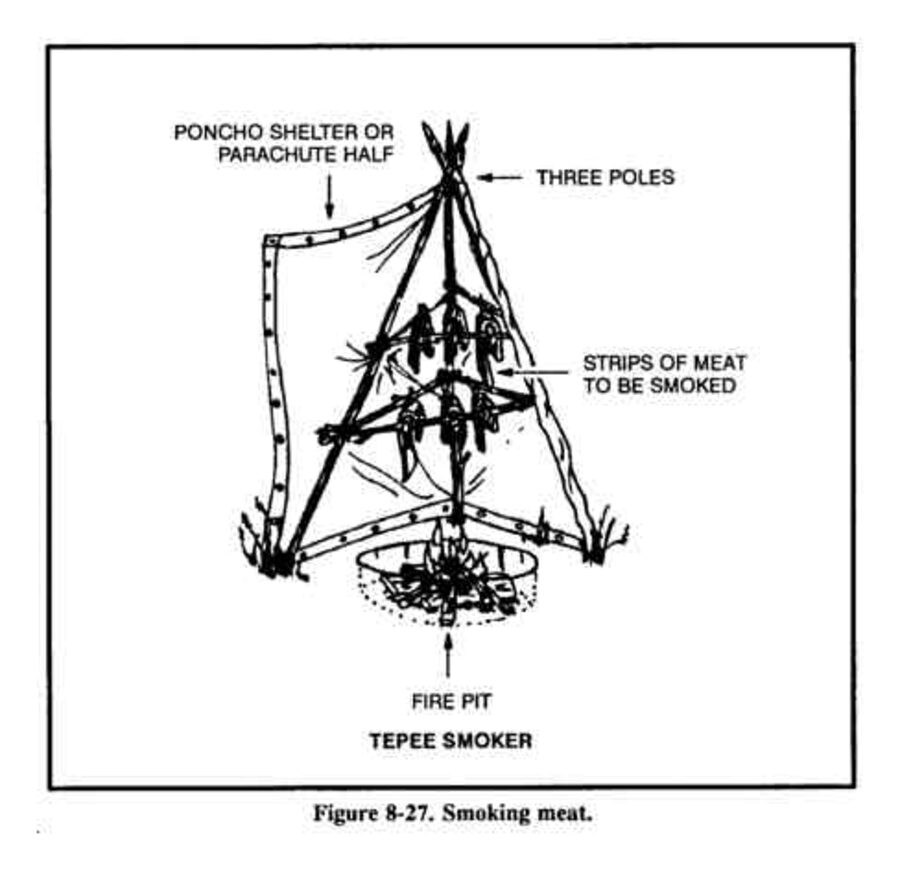
A tepee smoker: three poles, a poncho, meat strips over a small fire Use somewhat green hardwood for smoke; soak it if it is too dry. Never use pine or other sappy (resinous) wood, whose smoke ruins the meat. Keep the fire small; you want smoke, not heat.
The manual says meat smoked overnight keeps about a week, and two days of steady smoking keeps it 2 to 4 weeks. Well-smoked meat looks like a dark, curled, brittle stick.
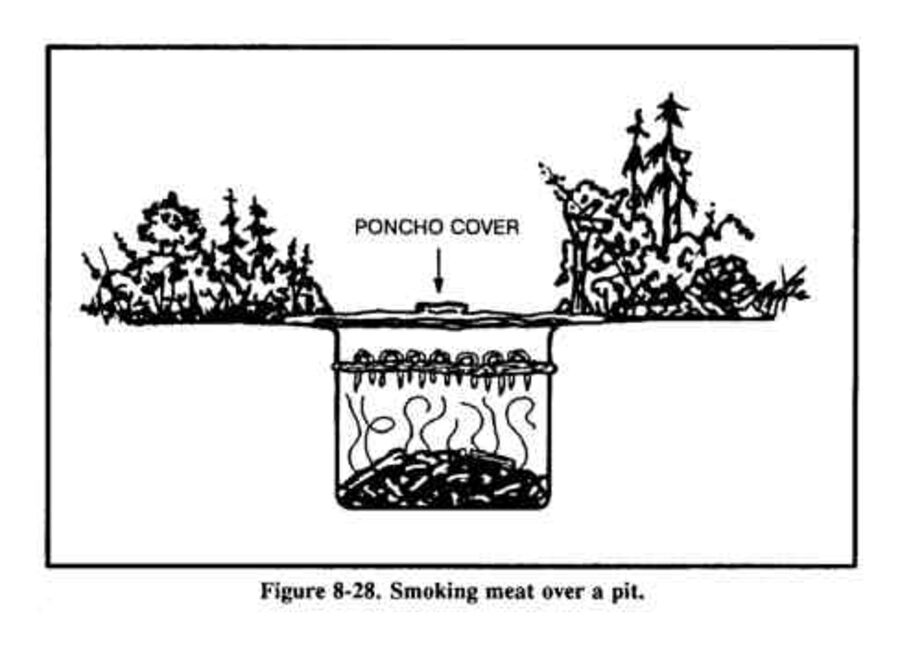
Smoking over a pit, covered with a poncho Fish: clean it as soon as you catch it, cut off the head and take out the gutsentrails The guts of an animal: stomach, intestines and other organs inside the belly. and the backbone, then smoke it the same way. Fish spoils fast, especially on a hot day, so do it the same day.
Anything that smells sour, feels slimy or grows mold is spoiled. Throw it out; cooking does not make spoiled meat safe.
Tips from survival instructors
- Slice meat across the grain for tender jerky and along the grain for chewy jerky.
- Keep dried meat in a sealed container in a cool, dry place, and check it for mold before eating.
Common mistakes
- Leaving fat on the meat. The fix: trim it all; fat goes rancid.
- Skipping the first heating to 160°F. The fix: heat first, then dry.
- Using pine or other sappy wood. The fix: green hardwood only.
- Letting the fire get hot. The fix: keep it small; you want smoke, not cooking.
Practice it safely
Make a batch of beef jerky at home with an adult, using a thermometer to reach 160°F before drying. Weigh the meat before and after; most of the weight that disappears is water.
Quick check
Why trim the fat before making jerky?
- Fat spoils and goes rancid
- Fat dries too fast
- It does not matter
Show the answer
Fat spoils and goes rancid
Take the quiz and earn the badge
The app checks your answers, keeps your place in the Trapping and catching food, and works with no signal once saved.
Before you rely on thisA learning tool, not a replacement for training. In an emergency, call 911. Do not eat any plant, berry or mushroom here. This app never tells you a wild food is safe.