Trapping laws are strict. In many states, deadfalls and string snares are illegal, and rabbits and squirrels may only be hunted, not trapped. A deadfall drops a weight; a snare is a loop that tightens. Rules change, so check your state wildlife agency's trapping regulations yourself before doing anything outdoors.
Trapping and fishing · Trapping and catching food course
How a trap trigger works
Why this matters
The survival manual says the heart of any trap or snaresnare A trap made of a loop of wire or cord that tightens around an animal that walks or pokes its head through. is the triggertrigger The part of a trap that holds tension until the animal moves it. The heart of every trap. Practice it, then take it apart.. Every trap gets its power from something simple: the animal's own struggle, gravity, or a bent young tree pulling. The trigger is the small part that holds that power back until the right moment.
Learning how a trigger works is good woodcraft: it teaches careful knife work, how forces balance, and patience. Setting a trap is a different thing. In many states, deadfallsdeadfall A trap that drops a heavy weight, like a log or rock, when an animal touches the trigger. and string snares are illegal, and rabbits and squirrels may only be hunted. So in this lesson you build the trigger on a table, watch it work, and take it apart.
What you need
- Three straight sticks of dead wood. The manual says freshly cut live wood oozes sap with a smell, and for practice you do not need to cut a living tree.
- A knife, and an adult nearby if you are young.
- A light board, a book or a piece of cardboard as the pretend weight.
- A table and some patience. The manual says this trigger takes practice.
Step by step
Outside a real emergency, build the trigger to practice, then take it apart. Never leave a trap set. A set trap left in the woods keeps working when you are gone. Taking it apart is also how you know you are done: all three sticks lie loose on the table.
The heart of any trap is the trigger: a part that holds tension until an animal moves it. The survival manual says traps crush, choke, hang or tangle an animal, and the power comes from gravity, a bent saplingsapling A young, thin tree, usually thinner than your wrist. Springy and easy to bend. or the animal itself. It suggests asking three questions: how should it affect the animal, what is the source of power, and what is the simplest trigger.
A figure 4 trigger uses three sticks with notches cut so they lock together under weight. Seen from the side, the sticks make the shape of the number 4: an upright post, a slanted stick resting on top, and a flat bait stick across the bottom. Tension is the push of the weight; it is the only thing holding the sticks together, which is why a small nudge makes it fall.
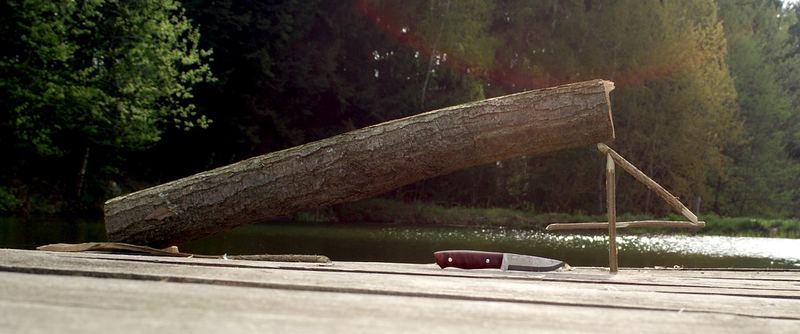
Three notched sticks lock together and hold the weight Cut the notches with a knife. It takes close fits and practice, so practice at home first. The manual says this trigger needs close fits and exact angles, which is why it takes practice. Cut away from your body. You did it right when the sticks lock together under a little weight and slip apart easily with a light touch.
Set it up on a table with a light board, nudge the bait stick, and watch it let go. You did it right when a light nudge drops the board every time. If it falls on its own, or will not fall at all, adjust the notches and try again. Keep your fingers out from under the board.
An animal caught in a real emergency must be handled with gloves and cooked all the way through. The winter survival handbook warns that animals can carry diseases you can catch by handling them, especially with cuts on your hands, and that thorough cooking destroys parasitesparasites Tiny worms or bugs that live in or on an animal (or you) and feed off it. Wild meat and water can carry them; full cooking or boiling kills them. in meat. It says cooked meat should reach at least 165 degrees F (74 C) inside.
Tips from survival instructors
- Carve and test triggers at home on a table. A good trigger releases with a light touch but holds steady until then.
- The manuals say to set many traps rather than one. Even experts catch something in only a few of them.
Common mistakes
- Cutting the notches too shallow, so the trigger will not hold, or so deep it will not let go. Make small cuts and test often.
- Cutting live branches for practice. Use dead sticks, and check park rules before collecting anything.
- Practicing with something heavy. A light book or piece of cardboard shows the same thing and cannot hurt your fingers.
- Leaving the trigger set anywhere, even in your yard. Take it apart every time.
- Handling a wild animal with bare hands. The manuals warn that animals can carry disease and that a cornered animal will fight.
Practice it safely
At a table, carve the three sticks and set the figure 4 under a light book. Nudge the bait stick and watch it fall. Do it again and again until you can set it in a minute, then take it apart and put the sticks away. You can sketch the shape first so you know where each notch goes.
That is the whole practice: the trigger stays on the table. Never bait it, never set it outdoors, and never leave it set. Use dead wood you find on the ground where collecting is allowed, and leave no trace.
Quick check
Outside a real emergency, what do you do with a trigger you built?
- Leave it set on the trail
- Practice with it, then take it apart
- Bait it and check tomorrow
Show the answer
Practice with it, then take it apart
Take the quiz and earn the badge
The app checks your answers, keeps your place in the Trapping and catching food, and works with no signal once saved.
Before you rely on thisA learning tool, not a replacement for training. In an emergency, call 911. Do not eat any plant, berry or mushroom here. This app never tells you a wild food is safe.
Sources
- US Army Survival Manual, pages 99 to 101 and 108
- Your state's hunting and trapping rules
- US Army Survival Manual, pages 99 (do not use freshly cut live wood), 101 (how traps work, power sources, the trigger is the heart of any trap) and 107 to 108 (figure 4 trigger, practice beforehand, Paiute deadfall parts)
- Marine Corps Winter Survival Handbook, pages 96 to 98 (wildlife diseases from handling animals, cooking meat thoroughly)
Photo credits
Photo: michael pollak, CC BY 2.0, source