Control panic, yours and the injured person's. Look for the cause. Follow the ABCs, airwayairway The open path for air from the nose and mouth down to the lungs. If it is blocked, nothing else matters for long. and breathing first, but the survival manual adds a warning: a spurting arteryartery A blood vessel that carries blood from the heart under high pressure. A cut artery spurts bright red blood. can kill faster than a blocked airway, so be discerning. ABC stands for Airway, Breathing and Circulation (the blood). Normally you check them in that order, but if blood is spurting, stopping it may come first. Speak calmly and keep the person still and quiet; panic makes everything harder.
First aid · First aid course
Stop the bleeding
The survival manual says it plainly: serious bleeding must be controlled at once, because there is no replacement fluid in the field and a person can die in minutes. The order is direct pressure, elevationelevation How high a spot is above sea level., pressure dressingpressure dressing A thick wad of padding over a wound, wrapped tightly with a bandage and knotted over the wound. The next step when hand pressure alone has not stopped the bleeding., pressure points, and a tourniquettourniquet A wide band twisted tight around an arm or leg above a wound to stop blood flow entirely. A last resort when everything else has failed or the limb is severed, because it can cost the limb. only as a last resort.
Why this matters
Bad bleeding is the injury that can kill fastest. The survival manual says that in the field there is no fluid to put back into the body, so a person can die within minutes. Losing about 1 quart (1 liter) of blood brings on shock, 2 quarts (2 liters) is severe shock, and 3 quarts (3 liters) is usually fatal.
The good news is that most bleeding stops with things you always have: your hands, firm steady pressure and a piece of cloth. The order in this lesson goes from the simplest and safest step to the riskiest, so you only move on when the step before it has failed.
If you have signalsignal Anything in threes means help: three fires, three whistle blasts, three piles of rocks., call 911 first or have someone else call while you press. This lesson is a learning tool, not medical training. A hands-on first aid class is the best next step.
What you need
- Nothing but your hands to start. Firm pressure with a bare hand is the first and best tool.
- Something clean to press on the wound: gauzegauze Thin, loose-woven cotton cloth used to cover a wound or pack it to stop bleeding., a bandanna, a clean shirt.
- Padding and strips of cloth for a pressure dressing. The first aid manual says strips torn from a T-shirt or socks work.
- For a tourniquet, only as a last resort: a band of cloth at least 2 inches (5 centimeters) wide and a strong stick. Never wire or a shoestring.
Step by step
Know what you are looking at. Arterial blood is bright red and spurts with the heartbeat; it is the most dangerous. Venousvenous Venous blood comes from veins, which carry blood back to the heart. It is dark red and flows steadily, not in spurts. blood is dark red and flows steadily. Capillarycapillary The tiniest blood vessels, just under the skin. A scrape oozes slowly from them. bleeding is the slow ooze of a scrape. Spurts that pulsepulse The beat of the heart you can feel in the wrist or neck. Count beats for 15 seconds and multiply by 4 for beats per minute. with the heartbeat mean an artery, the most dangerous kind, so you act at once. A steady dark flow from a vein is usually easier to control, and an ooze from a scrape is not hard to stop.
Direct pressure is the most effective way to stop it. Put a dressing on the wound and press firmly with your hand. The first aid manual says hold it 5 to 10 minutes; the injured person can do this if consciousconscious Conscious means awake and able to respond. Unconscious means they cannot be woken. Semiconscious is in between.. Pressure must be firm enough to stop the flow and held long enough to seal the surface. The two manuals give different times: the first aid manual says 5 to 10 minutes, and the survival manual says to keep pressing up to 30 minutes before you add a pressure dressing. Either way, the pressure has to stay on long enough to seal the wound, so do not keep lifting the cloth to look.
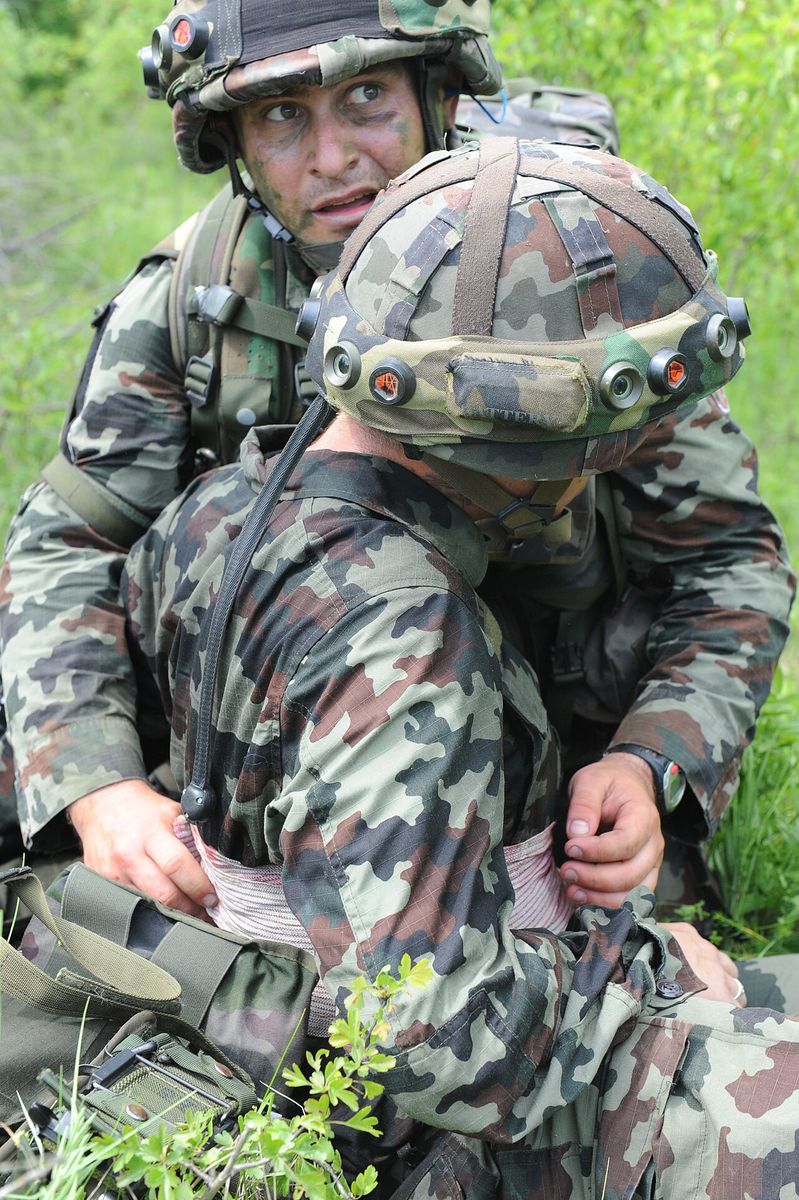
Direct pressure with a dressing on the wound Raise the limb above the level of the heart while you keep pressing. Elevation alone will not stop bleeding. Do not elevate a limb you think is broken until it is splintedsplint A stiff support, like sticks or rolled-up magazines, tied along a hurt arm or leg so it cannot move., and keep a snakebite below the heart. Raising the wound above the heart slows the blood reaching it, but it only helps alongside pressure. A broken arm or leg gets splinted first, then raised.
Still bleeding? Apply a pressure dressing: a thick wad of padding directly over the wound on top of the dressing, wrapped tightly with a bandage (strips torn from a T-shirt or socks work) and knotted directly over the wound. Tighter than an ordinary bandage, but not so tight it cuts off the limb. Tie the knot so it will not slip, and tie it right over the wound so the pressure lands there. You did it right when the bleeding slows or stops and the hand or foot beyond it stays warm and pink.
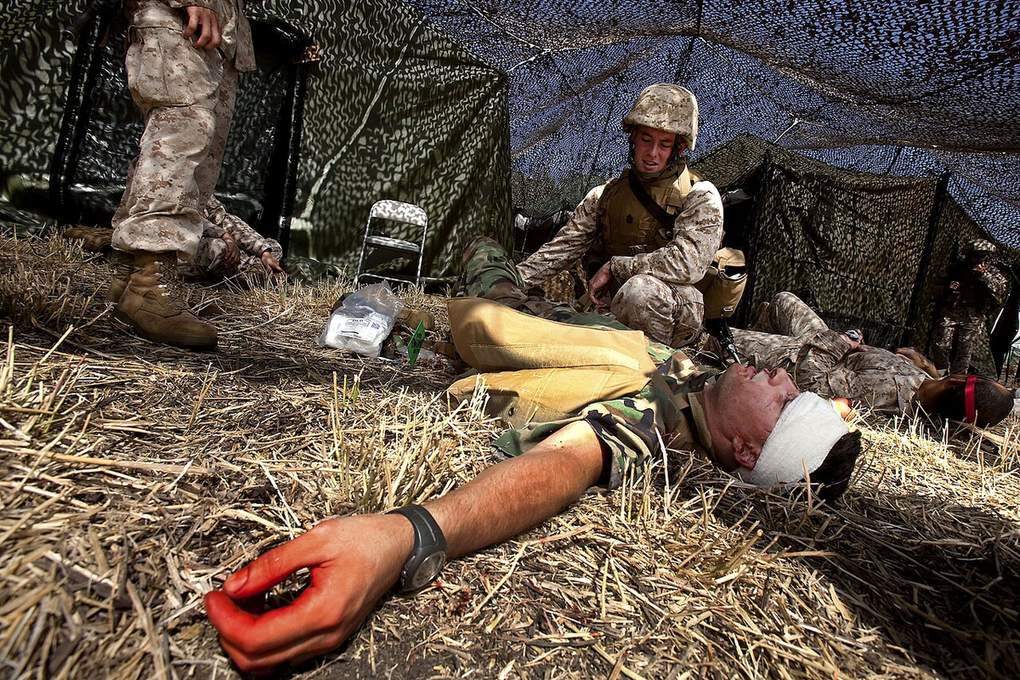
A thick pressure dressing tied firmly over the wound Do not take the pressure dressing off, even when it soaks through. Leave it 1 to 2 days, then replace it with a smaller one and check daily for infectioninfection Germs growing in a wound. Watch for redness that spreads, swelling, heat, pus, a bad smell or a fever.. Watch the hand or foot below it: cool, blue, gray or numb means loosen it. Taking a soaked dressing off undoes the work that pressure has done. If blood comes through, add more padding on top and keep pressing. After a day or two, swap it for a smaller one and check the wound each day for infection.
Pressure points slow arterial bleeding while you get a dressing on, by pressing the artery against bone at the joint just above the wound: the wrist for a hand, the ankle for a foot. They are less effective than direct pressure. Use great care at the neck, and never put a tourniquet around the neck. A pressure point is a spot where the main artery runs close to the skin or crosses a bone, so pressing it there slows the flow below. If you do not know the exact spot, press at the joint right above the wound. At the neck, too much pressure for too long can make a person pass out or worse.
A tourniquet is the last resort, used only when direct pressure and everything else has failed or the limb is severed, and only on an arm or leg where life is in danger. Left on too long it can cost the limb; put on badly it damages nerves. A tourniquet is a tight band that squeezes an arm or leg until blood stops flowing past it. The first aid manual adds that a limb that has been cut off may not bleed at first, but it will start again later, so a tourniquet goes on anyway.
How: a band at least 2 inches wide (never wire or a shoestring), placed 2 to 4 inches (5 to 10 centimeters) above the wound between the wound and the heart, never over the wound, a fracturefracture A broken bone. A closed fracture stays under the skin; an open one pokes through. or a joint. Pad under it. Tie a half knot, lay a stick on it, tie a full knot over the stick, twist until the bright red bleeding stops, then tie the stick down so it cannot unwind. If the wound is right below a joint, put the band right above that joint, as close as you can. Lay it over a smoothed sleeve or pant leg to protect the skin and wrap it flat. You did it right when the bright red bleeding stops; a little dark oozing for a short time can be blood that was already trapped below the band.
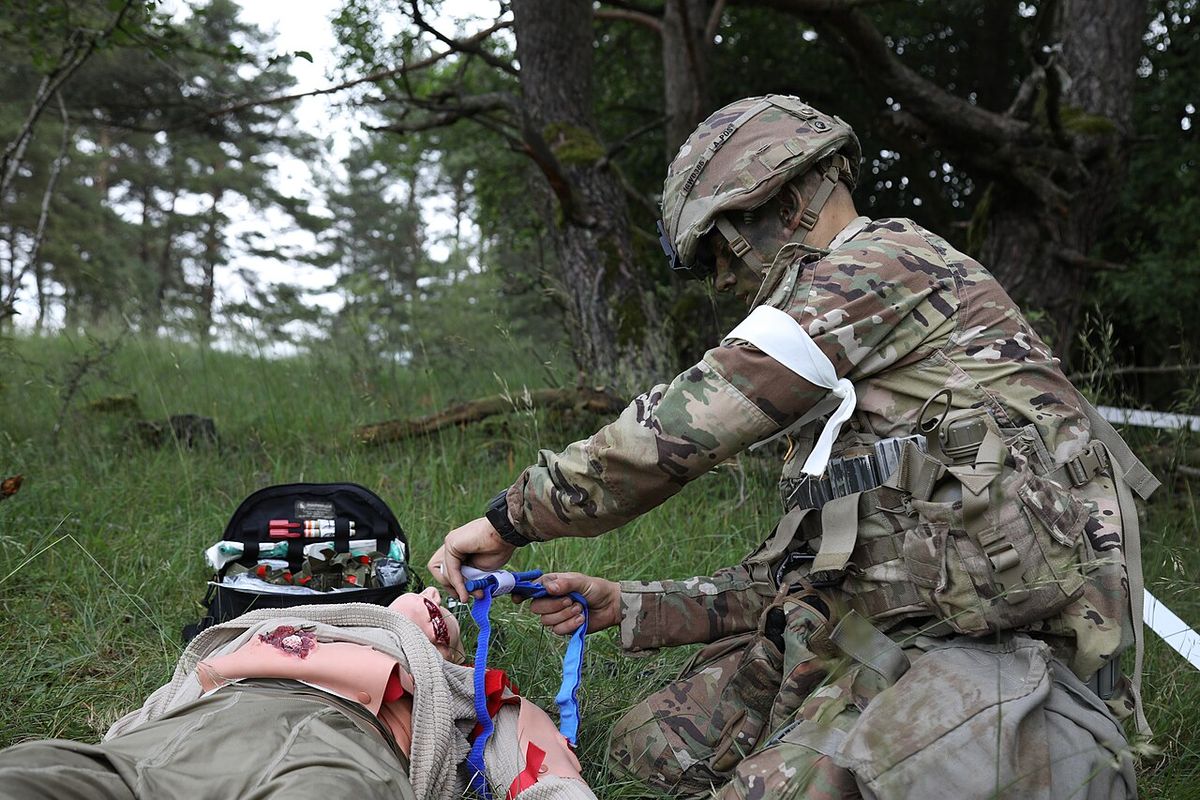
A wide band placed above the wound: the last resort Leave it in full view, mark a T on the forehead, treat for shock and get help. The first aid manual says do not loosen or release it once bleeding has stopped. The survival manual allows a companion to ease it for a minute or two every 10 to 15 minutes only when there is no help coming; a lone survivor never releases it. Leaving it uncovered and marking a T tells every helper later that a tourniquet is on. To treat for shock: if the person is awake, lay them flat with the legs raised 6 to 8 inches (15 to 20 centimeters); if they are not awake, put them on their side with the head turned so they cannot choke. Keep them warm, put something between them and the ground, and give nothing by mouth to someone who is not awake or has a belly wound.
Tips from survival instructors
- Press hard right on the wound with a cloth and do not let up to peek. Each look lets it start bleeding again.
- If the cloth soaks through, put another on top. Do not pull off the first one; that tears away the clot.
Common mistakes
- Lifting the cloth again and again to check. Keep steady pressure for the full time; the seal needs it.
- Pulling off a blood-soaked dressing. Leave it in place and add padding on top.
- Raising a limb that might be broken. Splint it first, then raise it.
- Using wire or a shoestring as a tourniquet, or putting it over the wound, a break or a joint. Use a wide cloth band 2 to 4 inches (5 to 10 centimeters) above the wound.
- Hiding the tourniquet under a jacket or blanket. Leave it in full view and mark a T on the forehead.
- Tying a pressure dressing so tight the hand or foot turns cool, blue, gray or numb. Loosen it until color and feeling come back.
Practice it safely
Practice with a friend at a table. Press a folded cloth on their forearm, then wrap a pressure dressing over a pad and tie it in a knot that will not slip, firm but not tight. Then check the hand below it: same color and warmth as the other hand, and the nail bed pinks up quickly after you press it. Untie it when you are done.
Practice the tourniquet steps (half knot, stick, full knot, twist, tie the stick down) on a rolled towel or a pillow, never tightened on a person. Pack a small kit with gauze, cloth strips and a wide band, and think about taking a hands-on first aid class. Remember that this lesson is a learning tool: in a real emergency, call 911 if you have signal.
Quick check
The pressure dressing has soaked through. What now?
- Take it off and look
- Leave it on; if it keeps bleeding, a tourniquet is the last resort
- Wash the wound
Show the answer
Leave it on; if it keeps bleeding, a tourniquet is the last resort
Take the quiz and earn the badge
The app checks your answers, keeps your place in the First aid, and works with no signal once saved.
Before you rely on thisA learning tool, not a replacement for training. In an emergency, call 911.
Sources
- US Army Survival Manual, pages 26 to 32 (lifesaving steps, control bleeding, tourniquet)
- Army First Aid Manual, pages 59 to 67 (manual pressure, elevation, pressure dressing, tourniquet)
- US Army Survival Manual, pages 26 to 33 (blood loss and shock, lifesaving steps, kinds of bleeding, direct pressure, pressure dressing, elevation, pressure points, tourniquet, treating shock)
- Army First Aid Manual, pages 59 to 67 (manual pressure, elevation, pressure dressing, circulation check, improvised tourniquet, marking and leaving it in view)