← Outdoor Survivalist Trainer Your area

Water · Water course

Water from snow and ice

In winter, water is everywhere and nowhere. Snow is mostly air, melting it costs fuelfuel wood Dead wood from finger to wrist thick that keeps the fire going once the kindling has caught., and eating it frozen makes you colder and drier. Here is how the cold-weather manuals do it.

Why this matters

In winter you are surrounded by frozen water but can still rungame trail A narrow path worn through grass or brush by animals using it over and over. A trap goes on a trail an animal already uses. short. The cold makes it easy to drink less than you need, and hard work in heavy clothes makes you sweat. The cold-weather handbook says to drink at least 3.5 quarts (about 3.3 liters) a day when you are working hard.

Snow is mostly air. FM 31-70 says 17 cubic inches of loose snow melts down to about 1 cubic inch of water, and the handbook says melting and boiling enough snow for one drink can take 30 to 40 minutes. That is why the manuals want you to use running water or ice first, and save fuel.

Eating snow as it is lowers your core temperaturecore temperature The heat deep inside your body, around your heart, lungs and brain. About 98.6 F when you are healthy. and can hurt your lips and mouth. The steps below show the safer ways.

What you need

  • A pot, can or canteen cup that never held fuel or oil, and a fire or stove.
  • No pot? A cloth or bag to hang snow near the fire, or a waterproof bottle or bag to melt snow with body heat.
  • Water treatment: tablets or a way to boilrolling boil Big bubbles breaking the whole surface, not just a few at the edge. One full minute of this kills the germs that make you sick..

Melting and boiling enough snow for a drink can take 30 to 40 minutes; a snow bag hung by the fire starts to drip in about half an hour.

Step by step

  1. Use running water if you can get to it. Melting snow is slow and burns fuel: a canteen cup packed with loose snow melts down to a few sips. A stream or a hole in lake ice gives you water without burning any fuel. Fuel and time are both hard to come by in the cold, so use running water whenever you can reach it safely. The MWTC handbook warns to be very careful at the edge so you do not fall into cold water.
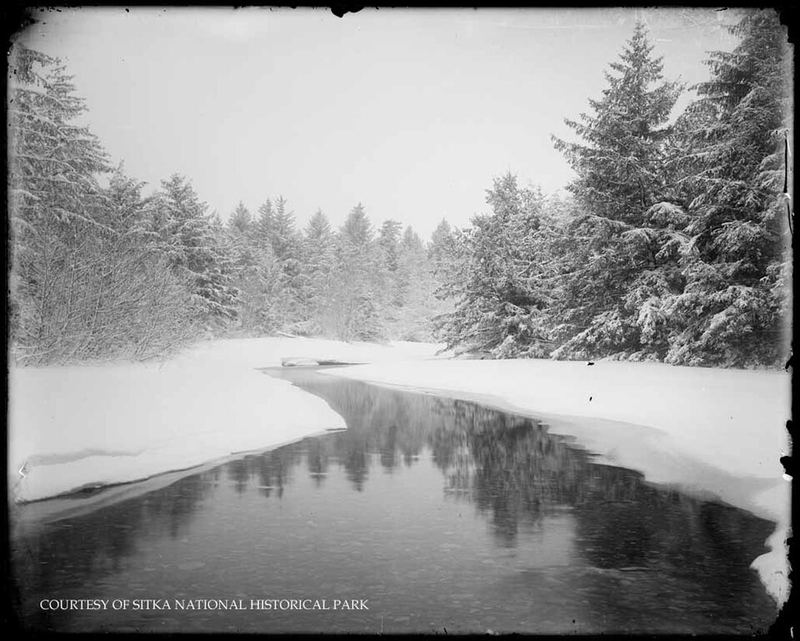
    Open dark water of a slow stream between snow-covered banks and spruce trees
    Open water in winter beats melting snow every time
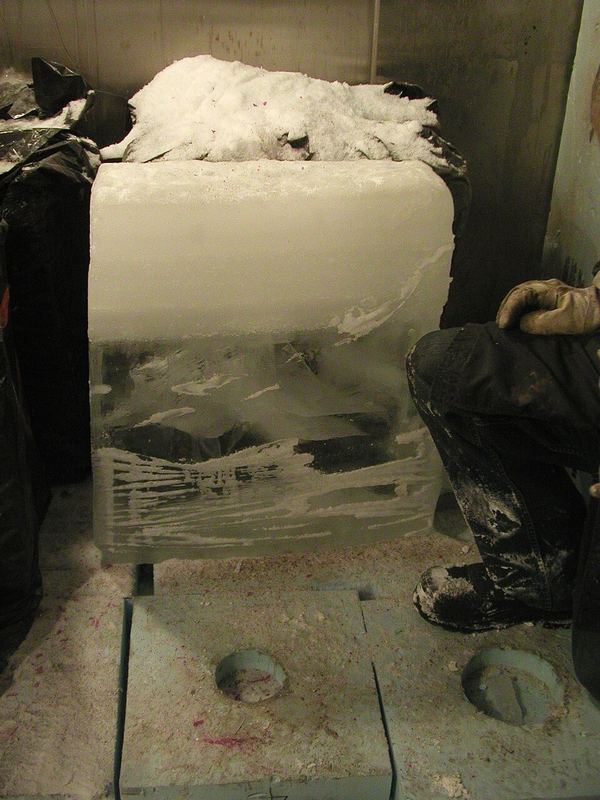
  2. Ice beats snow. Ice is dense, so a cup of ice gives far more water than a cup of snow for the same fuel. Clear ice from a lake or stream is best. The MWTC handbook says it takes about 3 to 4 cups of snow to make one cup of water. Ice is packed tight, so the same pot holds much more water. If you must use snow, FM 31-70 says to pick the most packed-down snow you can find.

    A block of ice with clear dense ice at the bottom and white snowy ice on top
    Clear ice is dense; the white part is mostly air
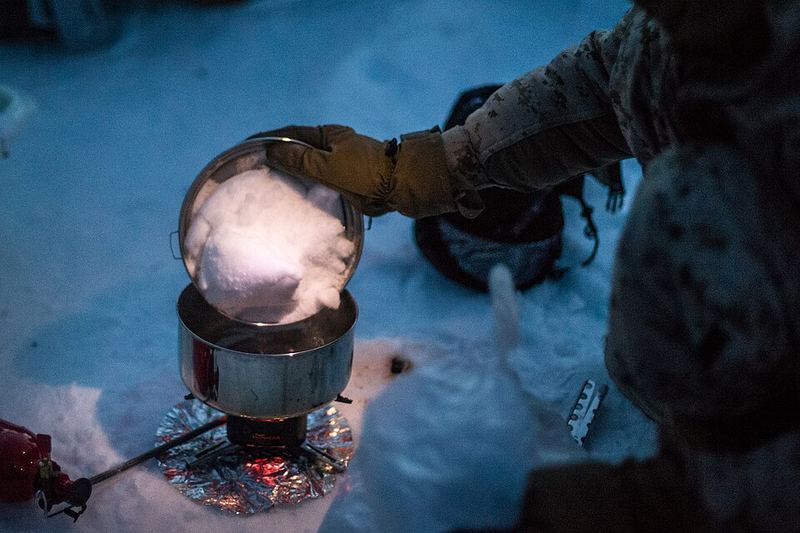
  3. Melt in a pot with a little water already in the bottom so the pot does not scorch. Stir, and add snow a little at a time. FM 31-70 calls this "priming." A dry pot full of snow can scorch or burn before the snow melts. With a little water in the bottom, the heat goes into melting. No water yet? Hold the pot near the heat and melt a small bit of snow in the bottom first.

    A gloved hand tips a lid of snow into a steel pot on a camp stove
    Add snow bit by bit to water already in the pot
  4. No pot? Put snow in a bag or a piece of cloth, hang it near the fire, and let it drip into a container. A hot rock dropped in a container of snow melts it fast. Hang the snow in a T-shirt or cloth bag on a stick or tripod close to the fire but not close enough to burn. Water drips from the low point into your cup. A hot rock dropped into a can of snow speeds things up and saves fuel.

  5. Body heat works: put snow in a waterproof bottle between layers of clothing, never against your skin, and let it melt as you move or sleep. Your body warms the bottle slowly as you walk or sleep. Keep it between layers so the cold bottle does not chill your skin. FM 31-70 also says you can keep a little water in a canteen under your clothes and add snow after each drink so the warm water melts it.

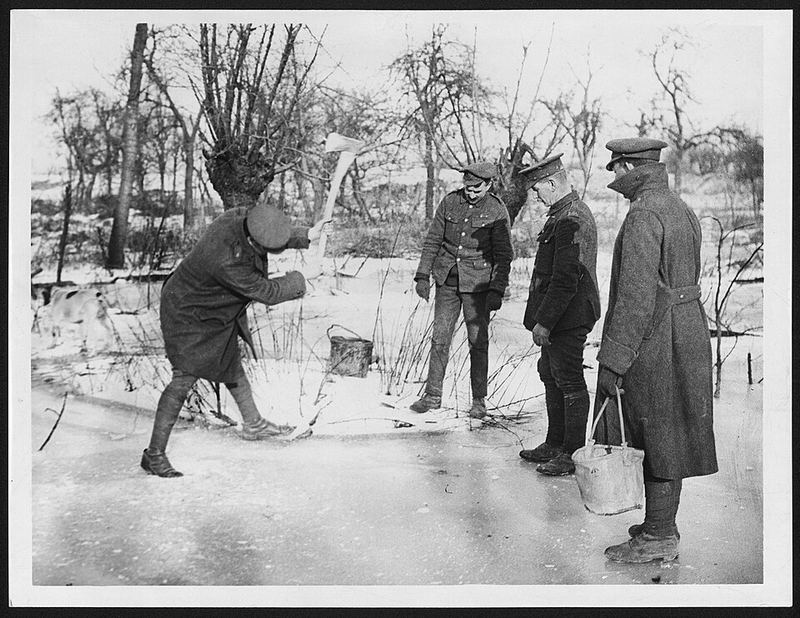
  6. A waterhole through lake ice: chop through, then cover the hole with a block of snow or a board and pile loose snow on top so it does not refreeze. Mark it so no one steps in it. A waterhole is a hole you chop through ice to reach the water below. The cover and loose snow on top act like a blanket so it does not freeze shut. Mark it with a stick tall enough that drifting snow will not bury it.

    A soldier swings an axe at ice while others wait with buckets
    A waterhole chopped through ice, with buckets ready
  7. If you must eat snow, warm it in your bare hand to the melting point first, then eat small amounts slowly while you are warm from walking. Weigh the frostbitefrostbite Frozen tissue, usually ears, nose, fingers or toes. Numb, then pale gray or waxy white. Superficial frostbite thaws with body heat; deep frostbite is never thawed in the field. risk to your hand against your thirst. This is the last choice when nothing else works. Warming snow in your hand until it starts to melt, then eating a little at a time, chills you less. Do it while you are already warm from moving. The cold can hurt your hand, so weigh that against how thirsty you are.

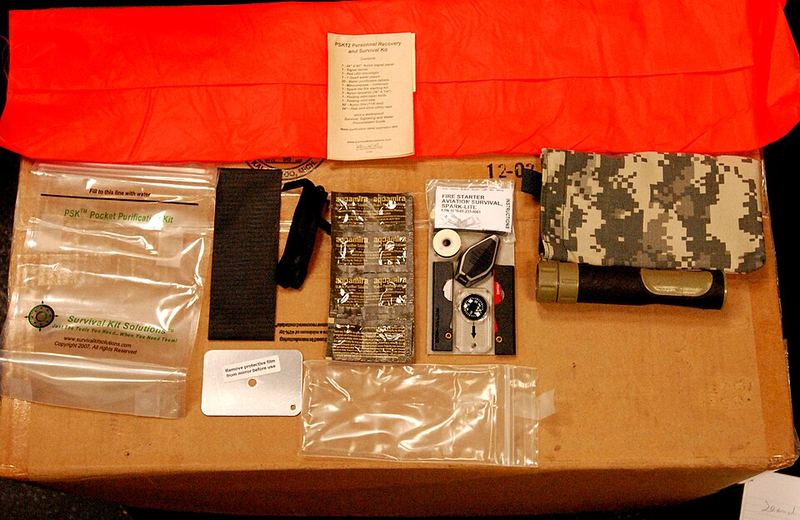
  8. Melted snow and ice still need treatment unless you are sure it is clean. Iodineiodine A brown chemical that kills germs. A few drops in clear water, then a 30-minute wait, makes it safer to drink. tablets or a boil are the cold-weather standard. The manuals differ on clean snow, so play it safe and treat it. FM 31-70 says purification tabletspurification tablets Making water safe to drink by killing the germs in it: boiling it, or adding tablets, iodine or plain bleach and waiting. need two to four times their normal half hour to work in freezing conditions.

    A pocket survival kit laid out with a blister pack of iodine tablets in the middle
    Iodine tablets ride in the smallest kit

Tips from survival instructors

  • Melting snow takes a lot of fuel and gives little water. Ice gives more water than the same pot of snow.
  • Put a little water in the pot first, then add snow a bit at a time. Snow alone in a dry pot can scorch the pot.

Common mistakes

  • Eating snow or ice as it is. Fix: melt it first; it lowers your body heat and can injure your lips and mouth.
  • Putting snow in a dry pot over high heat. Fix: start with a little water in the bottom, add snow a bit at a time and stir.
  • Using yellow, dirty or trampled snow. Fix: the manuals say to use clean, white snow from an area no people or animals have used, upwind and away from the latrinelatrine A spot set aside as a toilet. Keep it downhill and well away from water and camp.. Snow off tree branches works well.
  • Melting snow when a stream is close. Fix: the MWTC handbook says do not waste fuel on snow when drinkable water is available.
  • Letting your water freeze. Fix: FM 21-76 says to keep it next to you and not fill your canteen all the way, so the water can slosh and is slower to freeze.
  • Rushing chemical treatment in the cold. Fix: give tablets two to four times longer in near-freezing water.

Practice it safely

The next time it snows, try this in your kitchen with a grown-up. Pack one cup with loose snow and one cup with ice, let both melt and compare how much water you get. Then try melting snow in a pot with and without a little water in the bottom, and notice the difference.

Try the body-heat method on a winter walk: put a little snow in a sealed water bottle, tuck it inside your coat between layers, and check it after an hour. Stay off lake and stream ice; do not practice cutting a waterhole.

Quick check

You are cold and thirsty. Should you eat a handful of snow?

  • Yes, it is just frozen water
  • No, melt it first; eating it chills you and dries you out
  • Only if it is fresh
Show the answer

No, melt it first; eating it chills you and dries you out

Take the quiz and earn the badge

The app checks your answers, keeps your place in the Water, and works with no signal once saved.

Before you rely on thisA learning tool, not a replacement for training. In an emergency, call 911.

Sources

Photo credits
Photo: National Park Service, Public Domain, sourcePhoto: Lusilier, CC BY-SA 4.0, sourcePhoto: U.S. Marine Corps photo by Cpl. Ashley McLaughlin, Public Domain, sourcePhoto: National Library of Scotland, Public Domain, sourcePhoto: US Army Africa, CC BY 2.0, source

More on water