The sun rises in the east and sets in the west, though not exactly, and it varies with the season. In the northern hemispherehemisphere Half the Earth. The northern hemisphere is everything north of the equator, including all of the US. it is due south at its highest point, when a stick casts almost no shadow, and shadows move clockwise through the day. The sun does not rise exactly east or set exactly west, and it shifts with the seasons, which is why these methods are rough. At its highest point around midday, in the northern hemisphere, it is due south.
Finding your way · Finding your way course
Find north with a stick and the sun
With no compass, the sun still tells direction. The manual gives two ways: a shadow stick that works anywhere on earth, and a watch with hands. Both give a general direction, which is enough to keep you from walking in circles.
Why this matters
Without a compass, most people who try to walk straight drift and can end up going in circles. Knowing even a rough direction lets you hold a line, follow a plan and tell rescuers which way you went.
The sun crosses the sky in a pattern you can read. A stick and its shadow turn that pattern into a line on the ground that shows east and west, and from that you get north and south. The manual is honest that these methods give a general direction, not an exact one; that is still a big help.
What you need
- A straight stick about 3 feet (1 meter) long, a sunny day and two small stones or twigs to mark the ground.
- For the more accurate method: a piece of string.
- For the watch method: a watch with hands, or a paper circle you draw a clock face on.
- No stick? Any upright object that throws a clear shadow, like a fence post, will do.
About 15 to 20 minutes for the quick shadow-tip method; from morning to afternoon for the more accurate arc method.
Step by step
Shadow-tip: find a straight stick about 3 feet (1 meter) long and a level spot clear of brush where it will cast a clear shadow. Push it in and mark the tip of the shadow with a stone or twig. That first mark is always west, everywhere on earth. The sun moves across the sky from east to west, so a shadow moves the other way. That is why your first mark is always on the west side. Pick level ground so the shadow is not stretched by a slope, and push the stick in firmly so it does not lean or move.
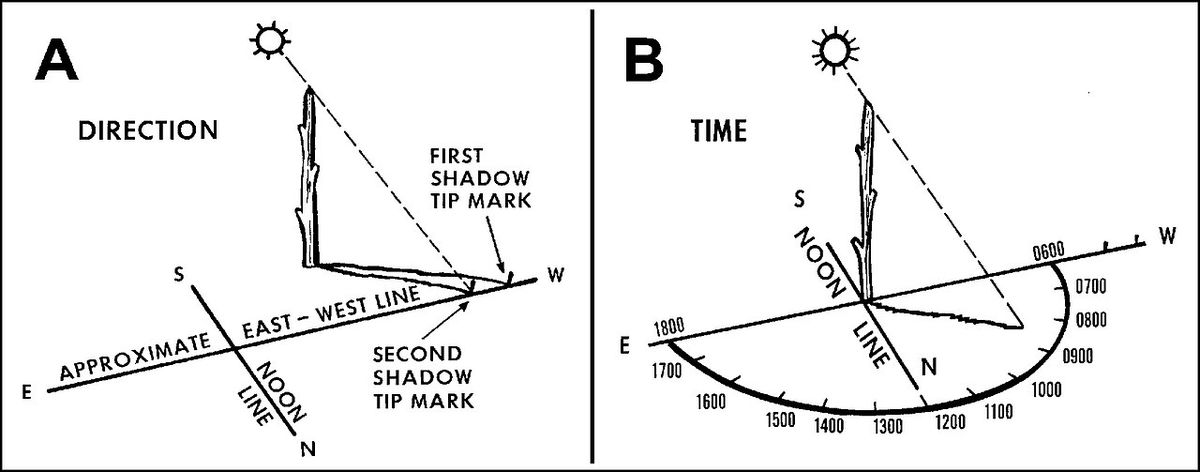
The manual's drawing of the shadow-tip method: mark the tip, wait, mark again Wait 10 to 15 minutes until the shadow tip has moved an inch or two (a few centimeters). Mark the new tip the same way. The tip has to move far enough that you can see two separate marks. If the marks are too close, your line can point a little wrong. Do not touch or move the stick between marks.
Draw a straight line through the two marks. That is an approximate east-west line. A line through the two marks runs about east and west. Lay a straight stick along it so it is easy to see. North and south rungame trail A narrow path worn through grass or brush by animals using it over and over. A trap goes on a trail an animal already uses. at right angles across it, like the shape of a plus sign.
Stand with the first mark (west) on your left and the second mark on your right. You are facing north. This is true everywhere on earth. Stand with your left foot near the first mark and your right foot near the second. The direction you face is north, behind you is south. You did it right if the sun is roughly behind you around midday.
For a more accurate line, take more time. Mark the morning shadow, then use a string to draw an arc through that mark around the stick. The shadow shortens through midday and lengthens again in the afternoon. Where the afternoon shadow tip touches the arc, make the second mark. The line through the two marks is an accurate east-west line. An arc is part of a circle. Tie the string to the stick, stretch it to the morning shadow tip, and scratch a curve on the ground around the stick at that length. The afternoon shadow will touch the same curve when the sun is at a matching height, which is why this line is more accurate than the quick method.
Watch method: use a watch with hands set to true local time, with no daylight saving adjustment. It is more accurate the farther you are from the equatorequator The imaginary line around the middle of the Earth, halfway between the North and South Poles.. With a digital watch, draw a watch face on paper with the correct time and use that. True local time means the time set by the sun itself, where noon is when the sun is highest. Clock time can be off from that because of daylight saving time and where you are in your time zone. No watch with hands? Draw a clock on paper showing the time and use it the same way.
In the northern hemisphere, hold the watch flat and point the hour hand at the sun. Halfway between the hour hand and 12 is the north-south line. If the watch is on daylight saving time, use the point halfway between the hour hand and 1 o'clock instead. Hold the watch flat, like a plate. Turn it until the short hour hand points at the sun. The point halfway between the hour hand and 12 lies on a line that runs north and south. Daylight saving time moves clocks an hour ahead, which is why you use 1 instead of 12 in summer.
Not sure which end is north? The sun is in the east before noon, in the west after noon, and due south at noon. The watch gives you a line but not which end is north. Use where the sun is: in the morning the sun is to the east, in the afternoon to the west. In the northern hemisphere the sun is to the south at midday, so the other end of your line is north.
Nature gives hints, not answers. Moss grows all the way around some trees, so it is not a reliable guide. Growth is lusher on the south side of trees, stumps show wider rings on the sunny side, and north-facing slopes stay cooler, damper and snowier. Use these with what you know of the terrainterrain The shape and kind of the land: hills, valleys, rock, swamp, forest.. These clues can disagree from tree to tree, so do not trust one alone. Look at many trees or slopes and see what most of them say. Then check it against the sun when you can.
Tips from survival instructors
- The sun rises roughly in the east and sets roughly in the west. At midday in the US it is in the southern part of the sky.
- Your shadow at noon points roughly north when you are in the US or anywhere north of the tropics.
Common mistakes
- Using a bent or leaning stick, or one on sloping ground. Fix: a straight stick pushed in firmly on a level spot clear of brush.
- Not waiting long enough between marks. Fix: wait 10 to 15 minutes, until the tip has clearly moved an inch or two.
- Mixing up which mark is which. Fix: the first mark is always west; label it with a different stone.
- Using the watch method without adjusting for daylight saving time. Fix: use the point halfway to 1 o'clock instead of 12.
- Trusting moss to show north. Fix: moss grows all around some trees; the manual says this saying is not accurate.
- Treating the result as exact. Fix: these methods give a general direction; combine them with landmarks and what you know of the land.
Practice it safely
This is a perfect backyard project on a sunny day. Do the quick shadow-tip method, then check your north line with a phone compass or a map of your street. Try the watch method at the same time and compare the two answers.
On a day when you are home, try the arc method: mark the morning shadow and draw your arc with string, then come back in the afternoon. In a park, use a stick you find on the ground rather than breaking one off a tree, and fill in any holes before you leave.
Quick check
Shadow-tip method: first mark on your left, second on your right. Which way are you facing?
- South
- North
- East
Show the answer
North
Take the quiz and earn the badge
The app checks your answers, keeps your place in the Finding your way, and works with no signal once saved.
Before you rely on thisA learning tool, not a replacement for training. In an emergency, call 911.
Sources
- US Army Survival Manual, pages 252 to 255 (sun and shadows, shadow-tip and watch methods) and 258 (other means of determining direction)
- US Army Survival Manual, pages 252 to 255 (general direction only, sun and shadows, shadow-tip methods, watch method, daylight saving time)
- US Army Survival Manual, page 258 (moss, tree growth, stumps, slopes)
- Military Survival and Rescue Guide, pages 16 to 17 (stick and shadow method, methods give only general direction, wristwatch and daylight saving)
Photo credits
Photo: United States Armed Forces, Public Domain, source