Know the numbers. North is 0 (or 360), east is 90, south is 180, west is 270. The number of degrees from north is called an azimuthazimuth A direction measured in degrees clockwise from north: 0 is north, 90 east, 180 south, 270 west. or a bearing.
Finding your way · Finding your way course
Use a compass: take a bearing and walk it
A compass needle always points to magnetic northmagnetic north The direction a compass needle points. It is near the North Pole but not exactly on it.. With that one fact you can walk in a straight line through thick woods, find your way back the way you came, and get around a swamp without getting lost. A bearingbearing A direction to travel, measured as an angle from north, like 90 degrees for east. is just a direction written as a number from 0 to 360.
Why this matters
In thick woods, fog or snow you cannot see landmarks, and people walk in circles without knowing it. A compass keeps you straight.
A cheap baseplate compass and 15 minutes of practice are enough to walk a bearing and find your way back.
What you need
- A baseplate compass with a turning dial (orienteering compass). Phones have compass apps, but batteries die and signalsignal Anything in threes means help: three fires, three whistle blasts, three piles of rocks. drops.
15 minutes to learn; an hour in a park to get good at it.
Step by step
Hold the compass flat and level at your belly, with the direction-of-travel arrow pointing straight ahead. Keep it away from metal, phones, cars and power lines, which pull the needle off.
Take a bearing to a landmark: point the travel arrow at it, then turn the dial until the outlined arrow on the dial lines up under the red north end of the needle. Read the number at the arrow. That is your bearing.
Walk the bearing: keep the needle "in the doghouse" (inside the outlined arrow) and look up along the travel arrow. Pick a tree or rock in that exact line, walk to it, then check again and pick the next one. Do not walk while staring at the compass.
Find your way back with a back azimuthback azimuth The exact opposite direction of an azimuth, used to retrace your steps. Add 180 if the number is under 180; subtract 180 if it is 180 or more., the opposite direction. If your bearing is less than 180, add 180. If it is 180 or more, subtract 180. Going out at 60 means coming back at 240.
Go around an obstacle like a pond or a cliff with right angles: turn 90 degrees, count your steps, walk past it on your original bearing, then turn back 90 degrees the other way and walk the same number of steps. You are back on your line.
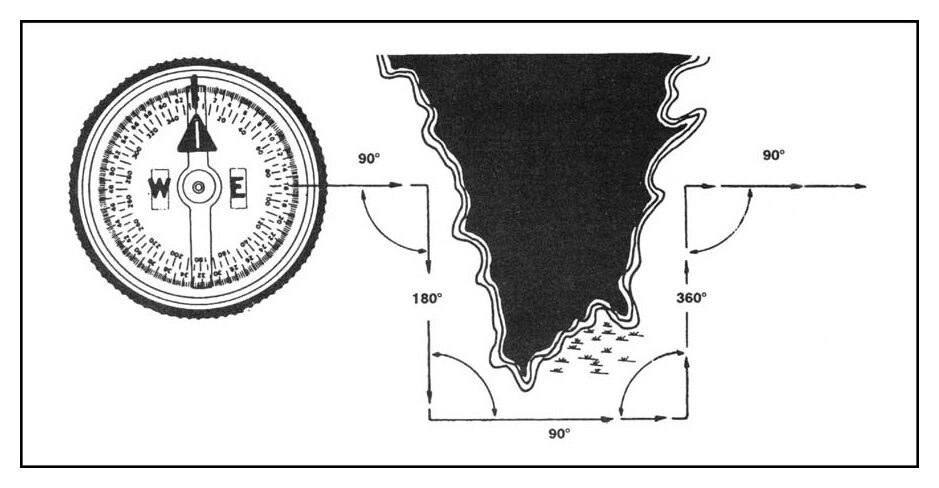
Going around a lake with right-angle turns Maps use true northtrue north The direction of the North Pole. The North Star sits almost exactly over it.; compasses show magnetic north. The difference is called declinationdeclination The difference in degrees between true north on the map and the north your compass needle points to.. It is printed on most maps. In much of the US it is small; in the far East or West it can be 10 degrees or more, so learn yours.
Practice in a park: set a bearing to a far tree, walk it, then turn around and walk the back azimuth to your start. If you come back to the spot you started, you have it.
Tips from survival instructors
- Pick far-off landmarks on your bearing, not close ones; they keep you straighter.
- Trust the compass over your gut. Feeling sure of a direction is exactly how people get lost.
Common mistakes
- Holding the compass near metal or a phone. The fix: keep it flat, level and away from metal.
- Walking while staring at the needle. The fix: sight a landmark, walk to it, repeat.
- Forgetting your bearing. The fix: write it down or leave the dial set.
- Mixing up the red and white ends of the needle. The fix: red is north on most compasses; check yours.
Practice it safely
In a park, set a bearing to a far tree, walk it, then walk the back azimuth to your start. Then lay out a square: walk 50 steps at 0, 90, 180 and 270. If you end where you started, you are doing it right.
Quick check
Why keep a compass away from your phone and a car?
- They are heavy
- Metal and magnets pull the needle off
- They block the sun
Show the answer
Metal and magnets pull the needle off
Take the quiz and earn the badge
The app checks your answers, keeps your place in the Finding your way, and works with no signal once saved.
Before you rely on thisA learning tool, not a replacement for training. In an emergency, call 911.
Sources
Photo credits
Photo: US Army, FM 3-25.26 Map Reading and Land Navigation (2001), Public Domain, source