Food guide
Squirrels and chipmunks: catch, clean and cook
Gray, fox and red squirrels live in every woodlot, are easy to find, and give a small, clean, tasty meal; chipmunks are too small to be worth it.
Page numbers below are from the US Army Survival Manual (FM 21-76) unless another source is named. Each one opens that page.
In many states, squirrels are game animals: you may take them only by hunting, in squirrel season, with a hunting license and a legal gun or bow. Trapping or snaring them is not allowed. Chipmunks are not game animals in many states, so leave them alone; they are also too small to be worth it.
Ways to catch it
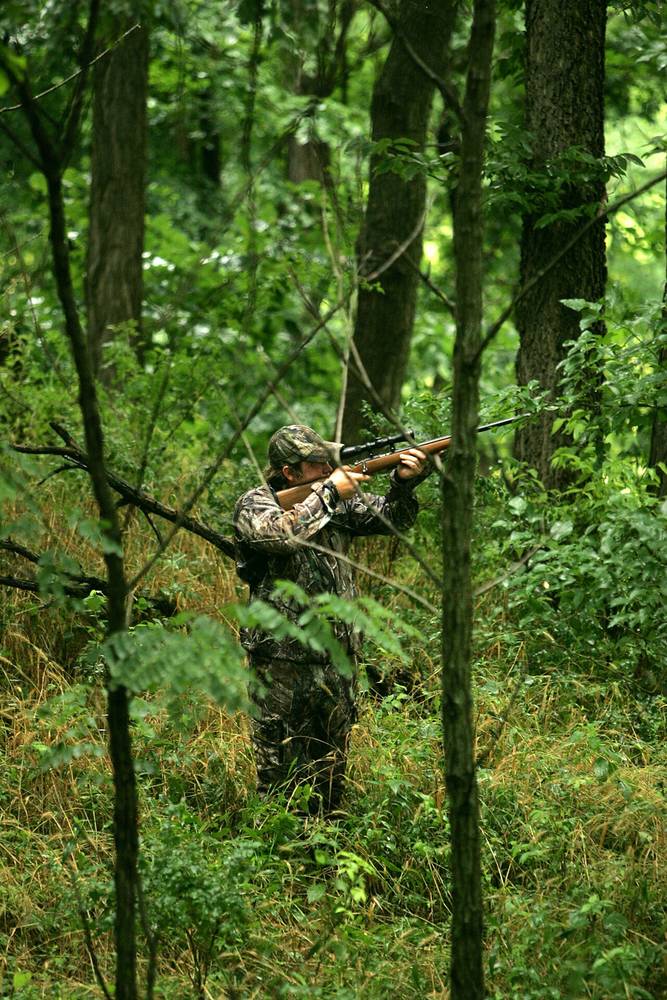 Hunting in seasonLicense and season
Squirrels feed most at dawn and late afternoon. Look for piles of chewed nut shells and leaf nests high in oaks and hickories. Sit still near a nut tree and wait; a squirrel that hears you will hide on the far side of the trunk.
Legal with a hunting license, in season, with a legal gun or bow. Check this year's state rules for dates and limits.
p. 99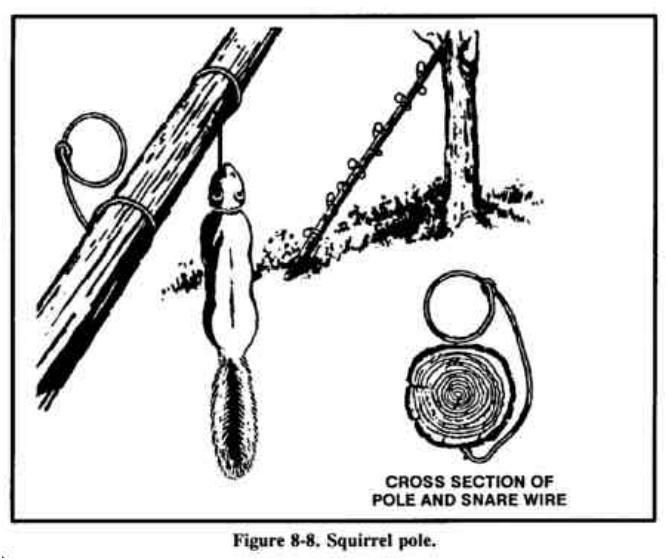 Squirrel polePractice only
The manual leans a long pole against a busy tree and wires several small loops (nooses) along it, about 5 to 6 cm wide and 2.5 cm off the pole. A squirrel running up or down the pole puts its head through a loop. Keep the top and bottom loops 45 cm from the ends so the squirrel cannot get its feet on something solid.
Snaring squirrels is illegal in many states. Build the trigger on a table to learn how it works, then take it apart. Never set it outdoors.
p. 104A heavy, bent hardwood stick, shaved flat like a boomerang. Point your free arm at the target, bring the throwing arm back, then forward until it is just above your pointing arm, and let go. It works best on small animals that freeze in place instead of running.
A thrown stick is not one of your state's legal hunting tools. Practice on a target, like a stump.
pp. 159 to 160Tie two cords about 60 cm long to the ends of a palm-sized piece of leather or cloth. Put a rock in the pouch, spin it a few times and let one cord go. It takes a lot of practice to hit anything.
A sling is not one of your state's legal hunting tools. Practice on a target.
pp. 112 to 113Clean it, step by step
Clean the squirrel soon after you get it, near a stream if you can. Wear gloves if you have them (general food safety, not the manual).
p. 121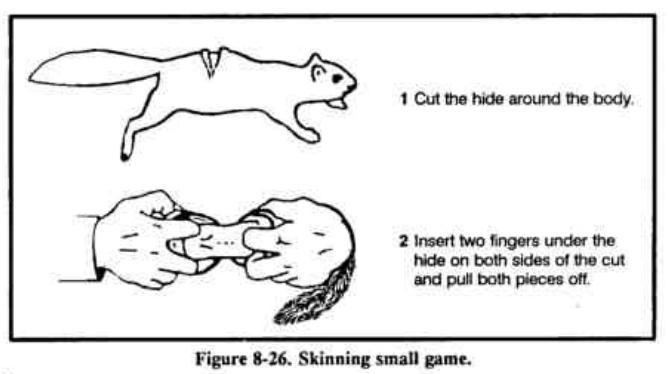
Pinch up the skin in the middle of the back and cut a short slit across it. Cut only the skin, not the meat.
p. 121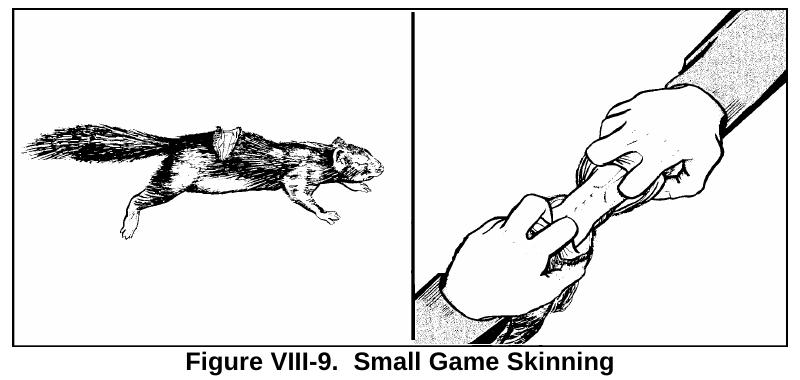
Push two fingers of each hand under the skin, one set on each side of the cut. Pull hard in opposite directions. The skin peels off toward the head and toward the tail like a sock.
p. 121Cut off the head, the feet and the tail.
p. 122Split the belly open from the bottom of the ribs to the tail. Do not cut the guts. Pull them out with your fingers, and do not forget the chest.
p. 122Keep the heart and liver. Cut them open and look for worms. A good liver is smooth, wet and deep red or purple. Throw away a spotted or odd-colored liver; the meat is still fine.
p. 122Rinse the meat in clean water when you are ready to cook it. Keep any hair off the meat.
p. 121
Cook it, step by step
Cut the squirrel into pieces: two back legs, two front legs and the back.
p. 122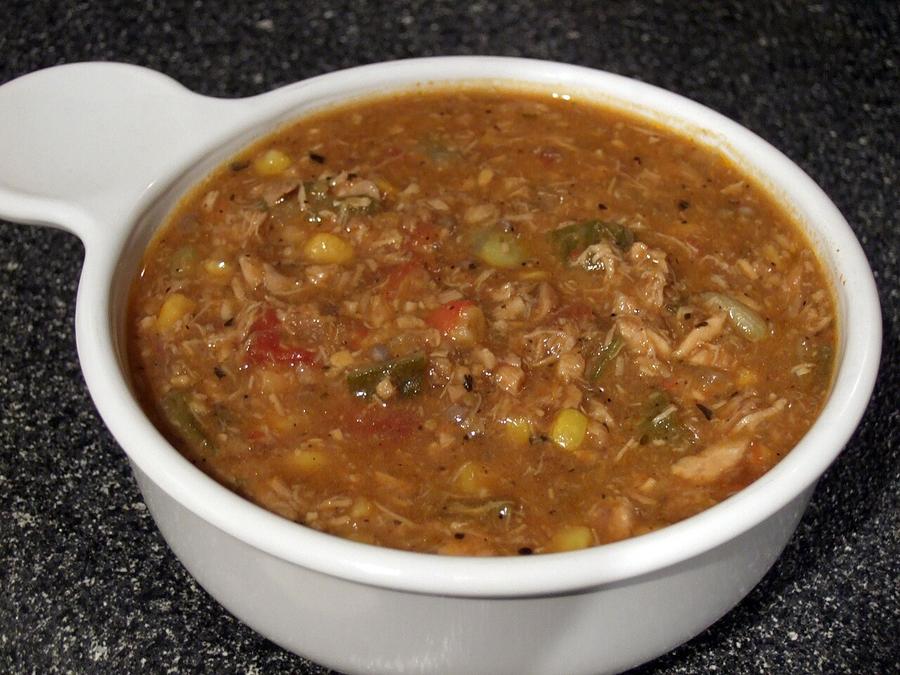
Boil the pieces in a pot until the meat is tender and pulls off the bone. Old squirrels are tough, so give them longer. Drink the broth; boiling keeps the most food value.
Military Survival and Rescue Guide, page 87Or roast the pieces on a stick over hot coals, turning them, until no pink is left near the bone.
p. 123Cook it all the way through. Wild meat should reach 165 F inside (general food safety, not the manual).
Military Survival and Rescue Guide, page 87
Stay safe
The app shows what has been seen near your ZIP code, with photos, and can read a photo you take.