Pick the largest clear, flat area on the highest ground you can reach, and make your signal as obvious as you can. High, open, flat ground can be seen from more directions and from farther away. A signal under trees or in a hollow is hidden from most angles. You chose well if you can see a lot of open sky all around you.
Signals and rescue · Signals and rescue course
Signals a pilot can see from the air
A search plane sees shapes, contrastcontrast How much something stands out from what is behind it: dark on light, bright color on green, straight lines in a natural place. and movement. The manual says what gets a pilot's attention: straight lines, circles, triangles or an X where nature makes none, a big fire or a flash of light, a large bright object moving slowly, and contrast of color or shadow. Build those.
Why this matters
People who are searching for you are often in the air, looking down at miles of trees, fields and snow. From up there a person is a tiny dot. The manual says what a pilot's eye catches instead: shapes nature does not make, such as straight lines, circles, triangles and an X, plus a big fire, a flash of light, something large and bright moving slowly, and strong contrast of color or shadow.
A ground signalsignal Anything in threes means help: three fires, three whistle blasts, three piles of rocks. works for you while you rest, fetch water or sleep. Searchers can pass over many times, so a signal that is already built and easy to see gives you a chance on every pass. Without one, a plane can fly right over you and never know you are there.
The manual's first rule for signals is to know how to use each one and have it ready on short notice. Building it early, before you hear an engine, is what makes it work.
What you need
- Nothing but your hands, if you have to. Rocks, branches, brush and snow can all make a symbol.
- Anything bright that contrasts with the ground: an orange vest, a colored jacket or tarp, a space blanket.
- For fire and smoke signals: a way to light a fire, dry fuelfuel wood Dead wood from finger to wrist thick that keeps the fire going once the kindling has caught., and green leavesdebris Dry leaves, pine needles, grass and ferns. Piled deep they trap still air, which is what keeps you warm. or moss to make white smoke.
- A flashlight or a cloth flag if you want to send SOSSOS The world’s distress signal: three short, three long, three short, in flashes, sounds or marks on the ground..
Step by step
Ground-to-air symbolsground-to-air Big symbols on the ground that a pilot can read from above, like a V for "need help." must be at least 3 feet wide and 20 feet long (1 by 6 meters). Make them bigger if you can, keeping the same 1 to 6 ratio. They must contrast strongly with the ground and sit in the open. Keep the lines straight and the corners sharp. The 1 to 6 ratio means each line is six times as long as it is wide, so a line 3 feet (1 meter) wide is 20 feet (6 meters) long. Long, skinny, straight lines look man-made from the air. Walk around your symbol and fix any line that bends or any corner that is rounded.
Spread clothing on the ground or in a treetop in a large geometric pattern. Choose colors that contrast with the surroundings. Any bright orange cloth works, and flashing a panel makes it easier to spot. Contrast means a color that looks very different from what is around it, like orange on green grass or dark cloth on snow. A large shape made of several items is easier to spot than one item lying alone. Moving the cloth catches the eye, so wave it when you hear a plane.
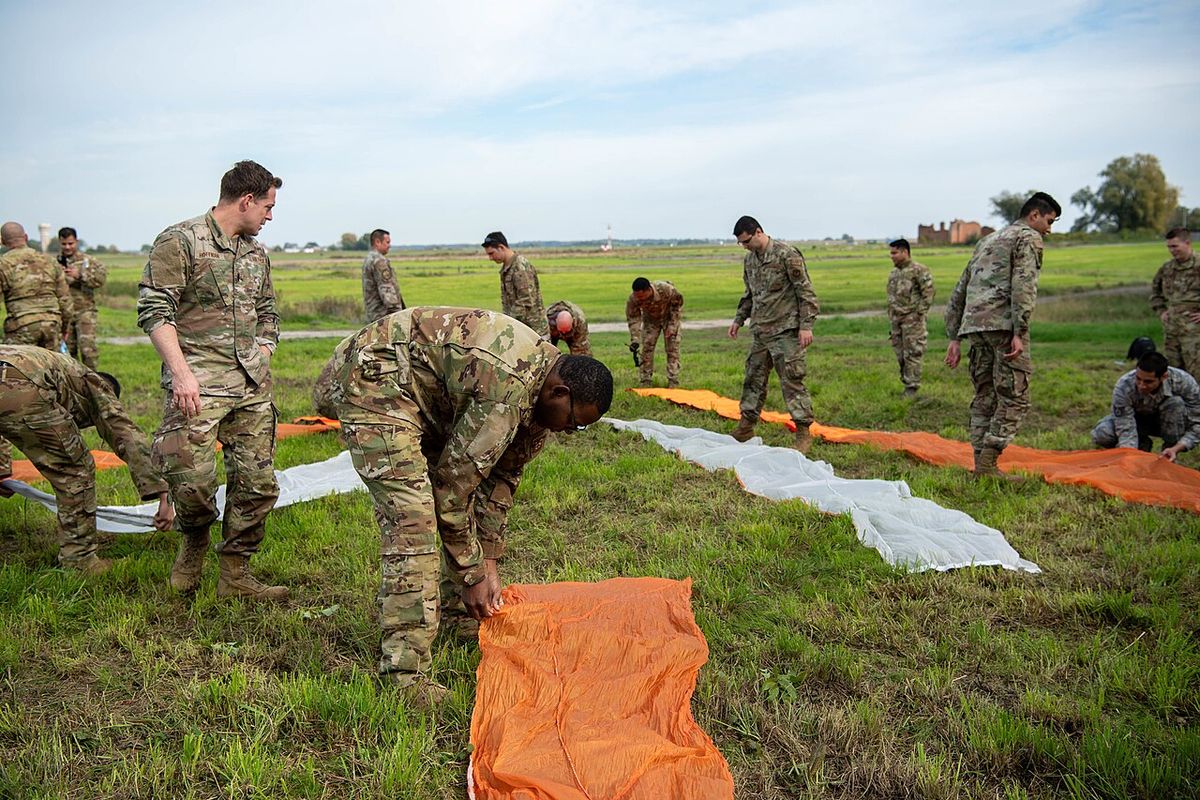
Bright cloth spread on open ground in a large geometric pattern No cloth? Build mounds that cast shadows from brush, rocks or snow blocks. In snow, tramp out letters and fill them with twigs or branches. In sand, use boulders, vegetation or seaweed. In brush, cut patterns in the growth or sear the ground. In tundra, dig trenches or turn the sod upside down. These ideas make shadows or color changes that a pilot can see. A mound casts a dark shadow on one side. Branches in trampled snow show dark against white. You did it right if your symbol stands out when you climb a little higher and look back at it.
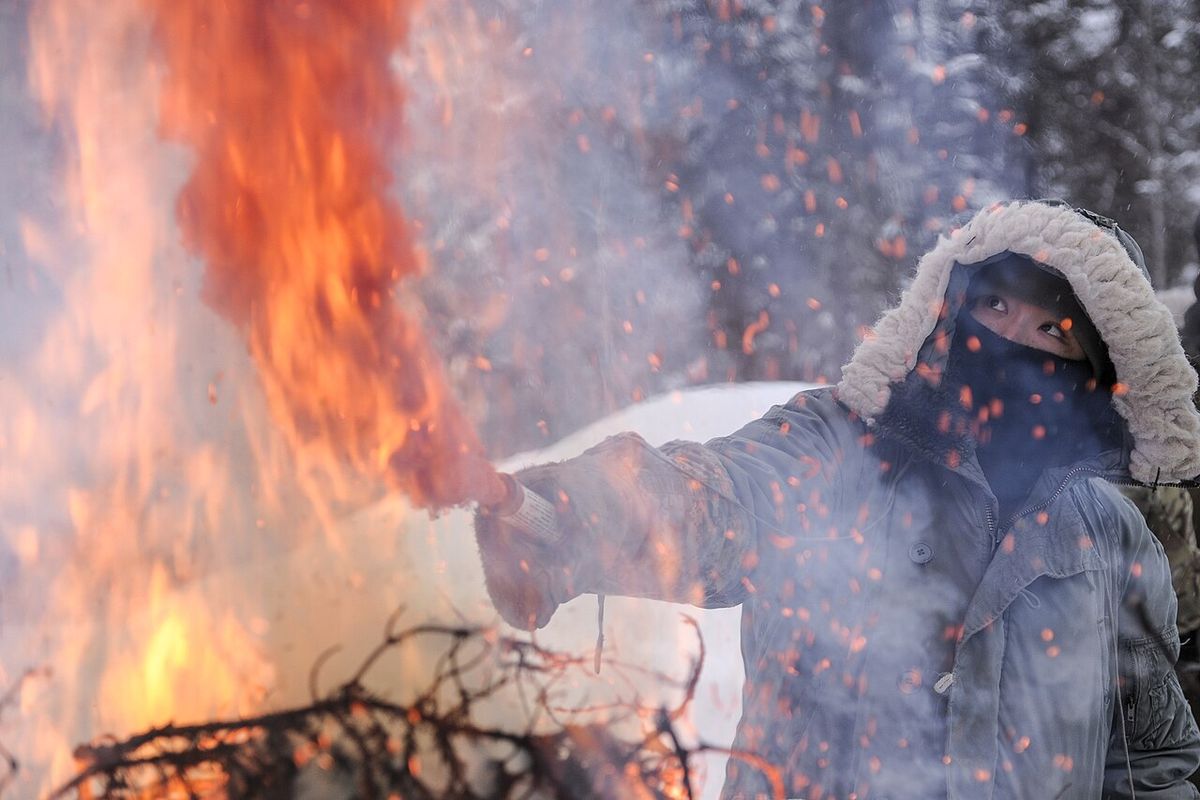
At night, fire is the best signal there is. Build three fires in a triangle or a straight line about 80 feet (25 meters) apart; that is the international distress signal. Build them early and protect them until you need them. Alone, one well kept fire is better than three that go out. Fire shows up best in the dark. Three fires in a triangle or a line are a known call for help. Keep the fires laid and ready but unlit, with dry fuel close by, so you can light them fast when you hear an aircraft. One fire you can keep going does more good than three that die out.
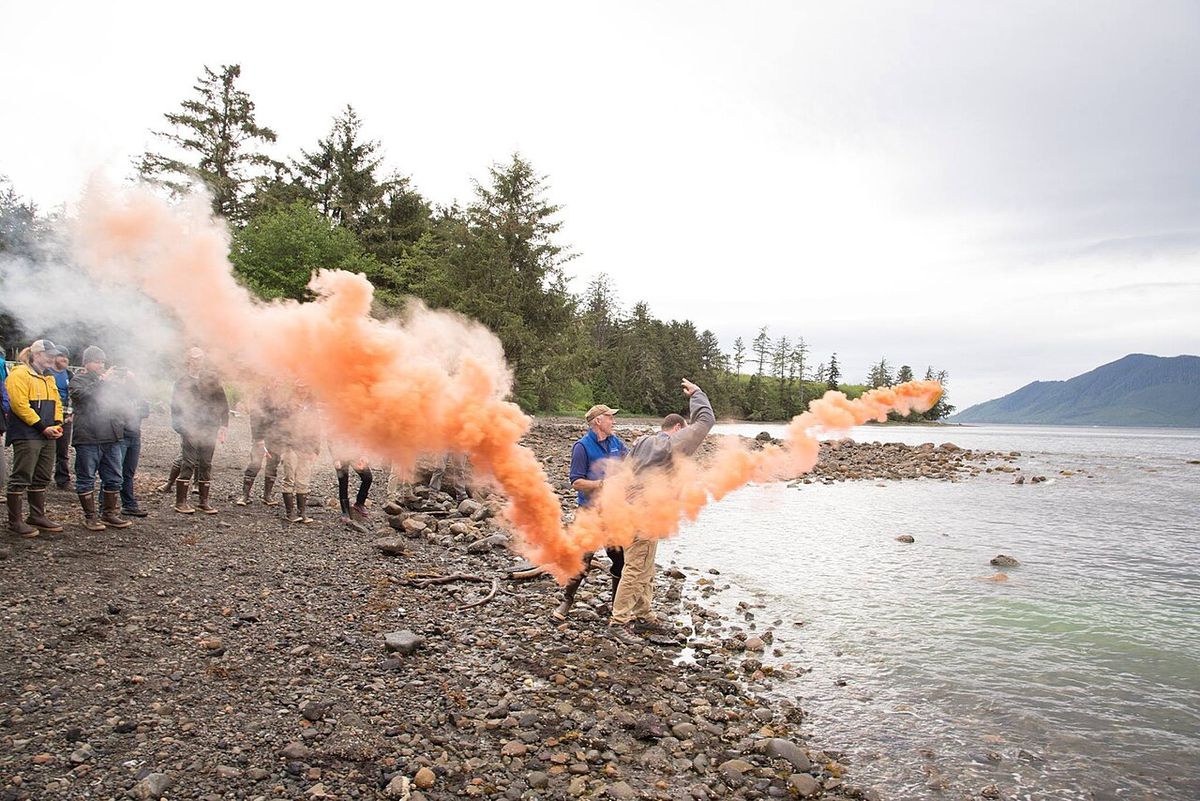
A big fire at night: build three in a triangle or a straight line By day, make smoke. Three columns is the distress signal. Smother a big fire with green leaves, moss or a little water for white smoke, or burn rubber or oil-soaked rags for black. Pick the color that contrasts with the background. Smoke works only on calm, clear days; wind, rain and snow scatter it. Smoke shows by day where flames do not. Pick the smoke color that is the opposite of the background: white smoke against dark forest, dark smoke against snow or bright sky. Wind, rain and snow scatter smoke, so on those days put your effort into other signals.
Smoke that contrasts with the background is seen by day With a light or a flag you can send SOS: three short, three long, three short, repeated. A flag held to the left is a dash, to the right a dot. SOS is the best-known call for help in the world. A dot is a short, sharp pulsepulse The beat of the heart you can feel in the wrist or neck. Count beats for 15 seconds and multiply by 4 for beats per minute. and a dash is a longer one. Keep repeating it with a short pause between each SOS so it is clear where one ends.
Three of anything says help: three fires, three whistle blasts, three shots at distinct intervals. Three of anything in a row is a pattern that does not happen by accident, so people read it as a call for help. Space the three out evenly so they are clearly separate.
Once a pilot has seen you, the manual says a fixed-wingfixed-wing An airplane with wings that do not move, as opposed to a helicopter. plane will usually tell you so by flying low, rocking the plane and flashing lights. Be ready with your next message. Watch for the plane to come in low, rock from side to side and flash its lights. That is the pilot saying the message got through. Have your next signal ready, such as the symbols from step 2 or a light to send SOS.
Being seen is not being rescued. Keep your shelter, water and signals going until someone actually picks you up. A search plane may have to go back and send a team on foot, a helicopter or a boat, and that can take a long time. Keep your fire, your water and your shelter going so you are in good shape when they arrive.
Tips from survival instructors
- Make shapes that do not happen in nature: straight lines, big Xs and Vs. Pilots notice straight lines and right angles.
- Bigger is better. A ground signal should be at least as long as several people lying head to foot, and stand out in color from the ground.
Common mistakes
- Building the signal under trees or in a low spot. Fix: move it to the largest clear, flat area on the highest ground you can reach.
- Making it too small or with wobbly lines. Fix: at least 3 feet wide and 20 feet long (1 by 6 meters), straight lines and sharp corners, and bigger if you can.
- Using colors that blend in, like green cloth on grass. Fix: pick colors that contrast strongly with the ground, and use shadows from mounds where you have no color.
- Waiting until a plane is overhead to build a fire. Fix: build signal fires early and protect them so they are ready to light right away.
- Making smoke on a windy or rainy day and counting on it. Fix: smoke works only on calm, clear days; use ground symbols, cloth and light on other days.
- Letting a signal fire spread. Fix: the manual says to choose an isolated spot so you do not start a forest fire and put yourself in danger.
Practice it safely
In a yard or an open park field, lay out an X or a straight line with old sheets, towels or bright jackets. Make each line 20 feet long and 3 feet wide. Then climb to a window, a hill or a play structure and look back. Which colors stand out most? Try the same with a few rocks or sticks and notice how much smaller and harder to see they are. Pick everything up when you are done and put rocks and sticks back where you found them; do not cut plants or dig in a park.
Practice SOS with a flashlight in your backyard at night: three short, three long, three short. Practice signal fires only where fires are allowed, such as a fire ring at a campground, with water nearby, and put the fire out cold before you leave.
Quick check
Where do you lay out ground signals?
- Under the trees, out of the weather
- On the largest clear, flat area on the highest ground you can reach
- Beside the shelter
Show the answer
On the largest clear, flat area on the highest ground you can reach
Take the quiz and earn the badge
The app checks your answers, keeps your place in the Signals and rescue, and works with no signal once saved.
Before you rely on thisA learning tool, not a replacement for training. In an emergency, call 911.
Sources
- US Army Survival Manual, pages 259 to 262 and 265 to 269 (signal fires, smoke, clothing, natural material, SOS, ground-to-air code, aircraft acknowledgments)
- Military Survival and Rescue Guide, pages 33 to 35 (pattern signals: size, shape, contrast)
- US Army Survival Manual, pages 259 to 262 (what gets attention, where to signal, signal fires, isolated tree, smoke color, calm days)
- US Army Survival Manual, pages 265 to 267 (orange panel, flashing it, clothing, natural materials, SOS, ground-to-air code size and ratio)
- US Army Survival Manual, pages 269 and 271 (aircraft acknowledgments, contact is not rescue)
- Military Survival and Rescue Guide, pages 33 to 35 (pattern signals: materials, location, size, straight lines and sharp corners, contrast)