Preparation also means knowing your route and the area, and leaving your body ready: the manual puts dental care and current immunizations on the list, because a toothache or an illness in the field takes away your ability to cope with everything else. Knowing your route and the area means you can tell rescuers where you are and pick the best way out. A toothache or a sickness in the field drains your energy for everything else, which is why the manual starts with health.
First hour · Before you go course
What to carry
The manual's definition of survival planning is short: realizing something could happen, and taking steps now. The biggest step is a small kit you carry on your body every time you go out, and knowing how to use what is in it.
Why this matters
You cannot plan when trouble will happen, but you can plan what you will have with you when it does. A small kit on your body goes everywhere you go, even if you lose your pack.
The manual says even the smallest kit, if put together with care, is worth a great deal in a survival problem. But a kit is only as useful as what you know. Learning to use each item matters as much as carrying it.
The first aid items in a kit do not replace training. This app is a learning tool, not medical training. If someone is hurt and you have signalsignal Anything in threes means help: three fires, three whistle blasts, three piles of rocks., call 911.
What you need
- A small, tough, water-repellent case: a tin, a first aid case or a zip pouch.
- Items from each of the six groups in the steps below.
- A night in the backyard to test everything.
Step by step
The environment decides the contents. How you carry the kit decides its size: a kit on your body is smaller than one in a vehicle. A hot desert kit and a winter kit look very different. Think about where you are going and how you will carry it. A kit that lives in your pocket has to be small.
Layer it. The most important items stay on your body; the manual's example is that the map and compass are always on your body. Less important items go on your belt or harness, bulky items in the pack. Layering means your most important things stay with you even if you set your pack down or lose it. If it only fits in the pack, it is not your first layer.
Choose things that do more than one job. If two items do the same thing, keep the one that also does something else. Do not duplicate; it adds size and weight. A knife that can also be a screwdriver, or a bag that can carry water and be a rain hat, saves space. Two things that do the same job only add weight.
The case should be water repellent or waterproof, easy to carry or attach to your body, able to hold odd-sized items, and durable. A bandage tin, a first aid case or a pouch will do. A case that leaks ruins matches and tindertinder The driest, finest material you have, which catches a spark or small flame: shredded inner bark, dry grass, birch bark curls, cattail fluff.. Pick one that seals and is easy to keep on your belt or in a pocket.
Six groups go in: first aid items, water purification tabletspurification tablets Making water safe to drink by killing the germs in it: boiling it, or adding tablets, iodine or plain bleach and waiting. or drops, fire starting equipment, signaling items, food procurement items, and shelter items. These six groups are the basics people need most: first aid, safe water, fire, being found, food, and staying sheltered. The MWTC handbook lists the same six. Check that your kit has at least one item from each.
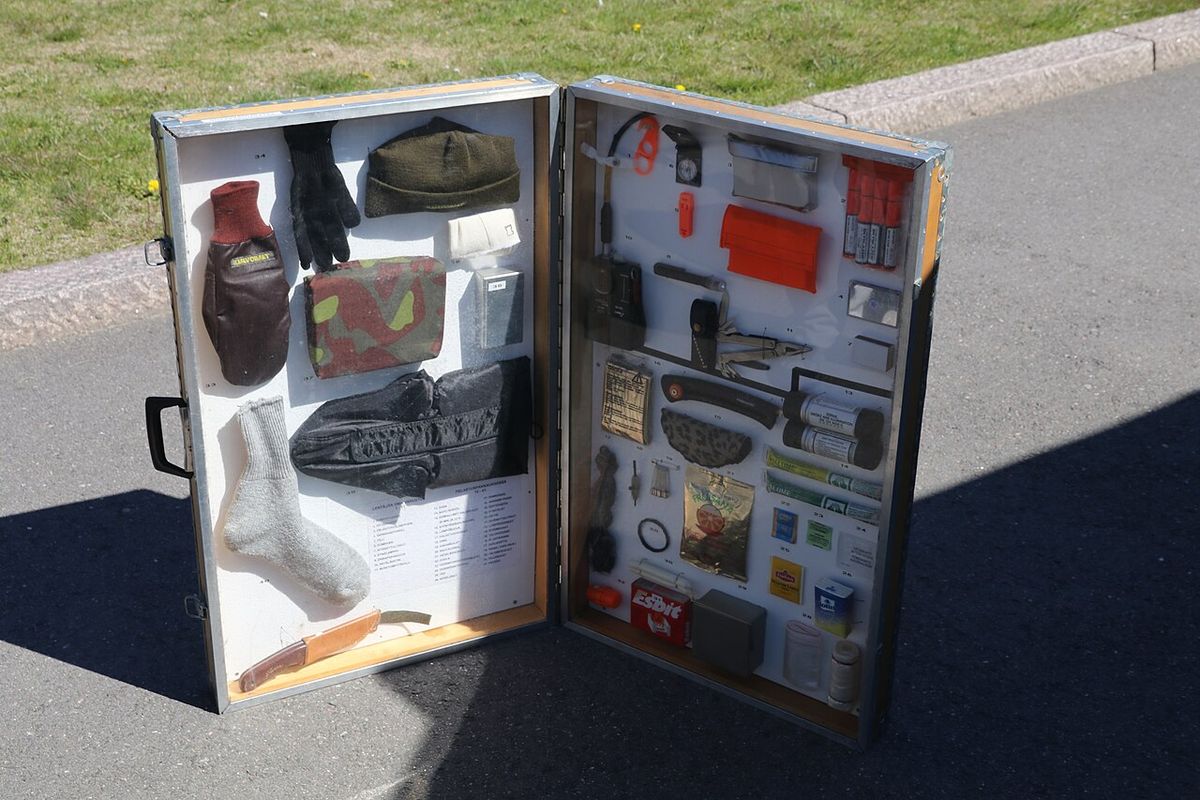
One kit, six groups: first aid, water, fire, signals, food and shelter The manual's example list: lighter, metal matchmetal match A rod of spark metal. Scrape a knife down it and it throws a shower of hot sparks into tinder. Works wet, so it belongs in every kit. and waterproof matches; snaresnare A trap made of a loop of wire or cord that tightens around an animal that walks or pokes its head through. wire; signaling mirror; wrist compass; fish and snare line; fishhooks; candle; small hand lens; water purification tablets; solar blanket; surgical blades; butterfly suturesbutterfly sutures Thin sticky strips that pull the edges of a small cut together, like stitches without a needle.; condoms for water storage; lip balm; needle and thread; knife. You do not need everything on the list. Pick what fits your trip. A solar blanket is a thin, shiny sheet that reflects your body heat. Lip balm also helps tinder burn. In many states, setting string snares is illegal, so in this app snare wire is for repairs and for building practice triggers on a table.
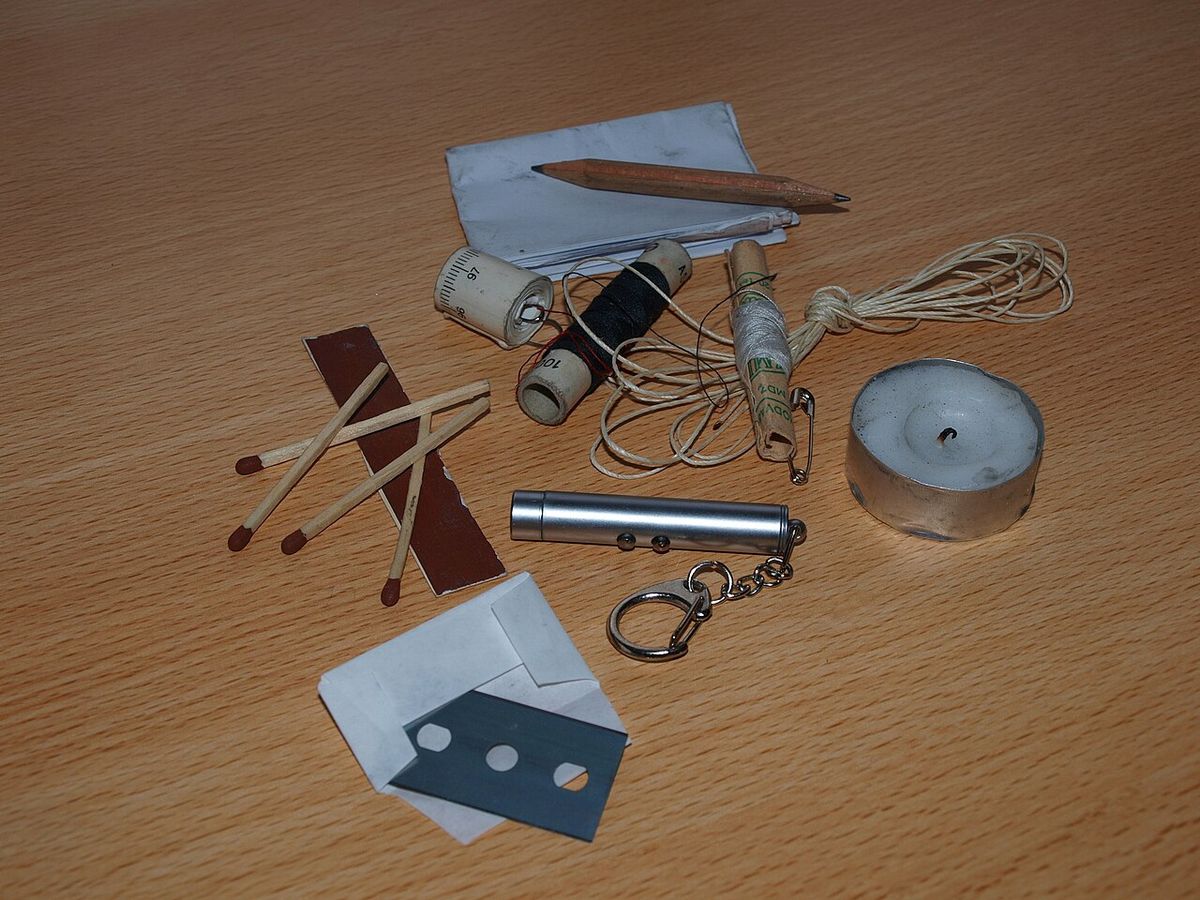
A pocket kit: matches, candle, cord, snare wire, blade and a small tin For cold weather it adds: a knife; waterproof matches in a waterproof container, ideally with a flint attached; a durable compass; map; watch; waterproof ground cloth and cover; flashlight; binoculars; dark glasses; fatty emergency foods; food gathering gear; and signaling items. Cold weather adds things for light, warmth and getting around in snow. Fatty foods give your body more fuelfuel wood Dead wood from finger to wrist thick that keeps the fire going once the kindling has caught. to make heat.
Test anything you have never used in an overnight backyard trial before you trust it. Once you have picked what is essential, do not lose it. Make charred clothcharred cloth Cotton cloth heated until it is black but not burned. It catches a spark and holds a glow long enough to light tinder from it. ahead of time and add it to the kit. An overnight backyard test means sleeping outside at home with only your kit and the gear you plan to bring. Anything that fails there would have failed on the trailgame trail A narrow path worn through grass or brush by animals using it over and over. A trap goes on a trail an animal already uses..
A kit runs out or wears out. Read and practice the techniques in the manual, and learn to improvise with what is around you. Skills keep working after the kit is empty. Every lesson in this app is a way to improvise, which means making do with what is around you.
Tips from survival instructors
- A kit only helps if you have it with you. Keep the small essentials in your pockets or on your belt, not only in your pack.
- Check your kit every few months. Batteries die, lighters dry out and medicines expire.
Common mistakes
- Packing the kit in the pack only. Fix: keep the most important items on your body.
- Carrying things you have never used. Fix: try each item at home first.
- Packing two things that do the same job. Fix: keep the one that can also do something else.
- A case that lets water in. Fix: use a sealed tin or pouch and keep matches in their own waterproof container.
- Forgetting a pot or cup for boiling water. Fix: the MWTC handbook lists a metal container that never held fuel or oil.
- Packing it once and never checking it. Fix: look it over before each trip and replace anything used, old or broken.
Practice it safely
Build your kit on the kitchen table. Lay out one item for each of the six groups, then cut down until it fits in your case. Ask yourself for every item: can something else I have do this job too?
Then do the manual's overnight backyard test with a grown-up: spend an evening or a night in your yard using only your kit. Light a fire only if your town allows backyard fires and you have water nearby. Make a list of what worked, what failed and what you missed, and fix the kit before your next trip.
Quick check
What must the kit case be?
- Metal
- Water repellent, durable and easy to carry on your body
- As large as possible
Show the answer
Water repellent, durable and easy to carry on your body
Take the quiz and earn the badge
The app checks your answers, keeps your place in the Before you go, and works with no signal once saved.
Before you rely on thisA learning tool, not a replacement for training. In an emergency, call 911.
Sources
- US Army Survival Manual, pages 17 to 19 (survival planning and survival kits), 86 (charred cloth) and 191 (cold weather items)
- US Army Survival Manual, pages 17 to 19 (survival planning, preventive medicine, layering, multi-use items, case, six groups, example items, practice the techniques), 85 to 86 (charred cloth) and 191 (cold weather items, overnight backyard test)
- Marine Corps Winter Survival Handbook, pages 6 to 8 (kit components, metal container, signaling and first aid items)