Fire needs three things: air, heat and fuel. Take any one away and it goes out. Getting the ratio right is the whole skill, and the manual says the only way to learn it is practice. Air, heat and fuel are called the fire triangle. Wood does not burn directly; heat turns it into a gas, and the gas burns with the air. Too much wood smothers it, too little air starves it.
Fire · Fire course
Four ways to lay a fire
A fire layfire lay How you stack tinder, kindling and fuel before you light it. Tepee, lean-to, log cabin and star are the common shapes. is how you stack tindertinder The driest, finest material you have, which catches a spark or small flame: shredded inner bark, dry grass, birch bark curls, cattail fluff., kindlingkindling Pencil-thin dead twigs that catch from tinder and build the fire up. They should snap, not bend. and fuelfuel wood Dead wood from finger to wrist thick that keeps the fire going once the kindling has caught. before you strike anything. The manual gives four, each with a job: the tepeetepee A fire lay shaped like a cone: kindling leaned in a circle over the tinder. Catches fast, even with damp wood. for a fast start even with damp wood, the lean-to for wind, the cross-ditch for draft, and the pyramid for a fire that burns itself down through the night.
Why this matters
A fire lay is how you stack the wood before you light it. A good lay lets air reach the flame and lets the fire climb from tinder to kindling to fuel on its own. A bad lay smothers the flame, burns out too fast or blows out in the wind.
Each lay has a job. Pick the one that fits the weather and what you need the fire for: a fast start, a windy spot, a cooking bed of coals, or heat that lasts through the night.
What you need
- Tinder, kindling and fuel wood, gathered by hand.
- A stick or a flat rock to scratch a cross-ditch or dig a DakotaDakota fire hole A fire built in a hole in the ground, with a second tunnel feeding it air. Hard to see, and it burns hot on little wood. hole.
- A green stickgreen wood Wood cut from a living tree, still full of sap. It will not burn easily, which is why it makes the base under a fire on snow and the reflector wall behind one. for the lean-to lay.
- Water to put it out.
Step by step
Gather everything before you light anything: tinder that ignites from a spark, kindling that catches from the tinder, and fuel that burns slowly once lit. Tinder and kindling must be absolutely dry. Once a flame is going it will not wait for you. Have all three sizes sorted within reach before you strike anything.
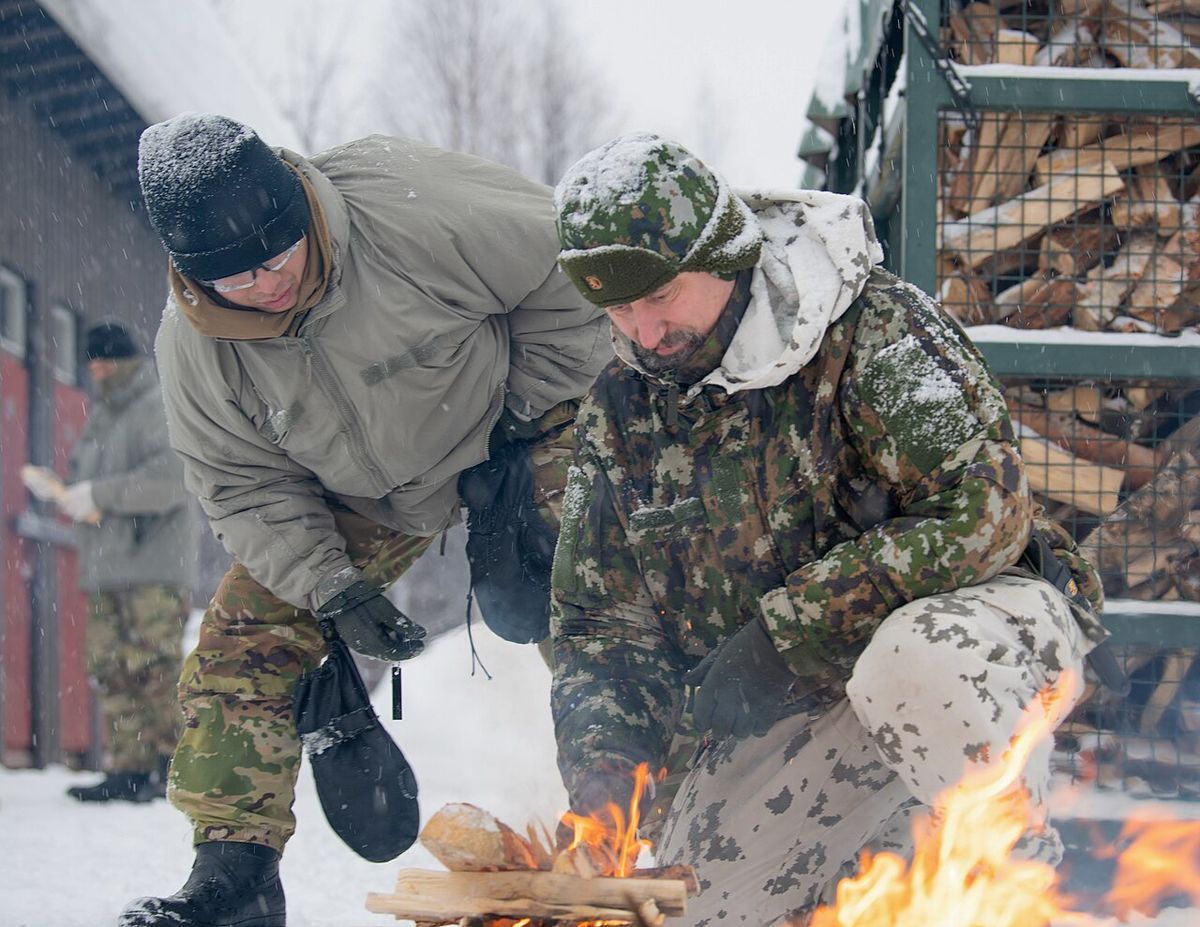
Tinder, kindling and fuel sorted and ready before the first flame Tepee: arrange the tinder and a few sticks of kindling in the shape of a cone. Light the center. As it burns, the outside sticks fall inward and feed the fire. This lay burns well even with wet wood. In a tepee, the flame climbs up the cone and heats the sticks above it, which dries them as they burn. FM 21-76-1 says this lay makes a strong, focused heat for cooking or signaling. The MWTC handbook says to knock it down into a flat bed once you have plenty of coals.
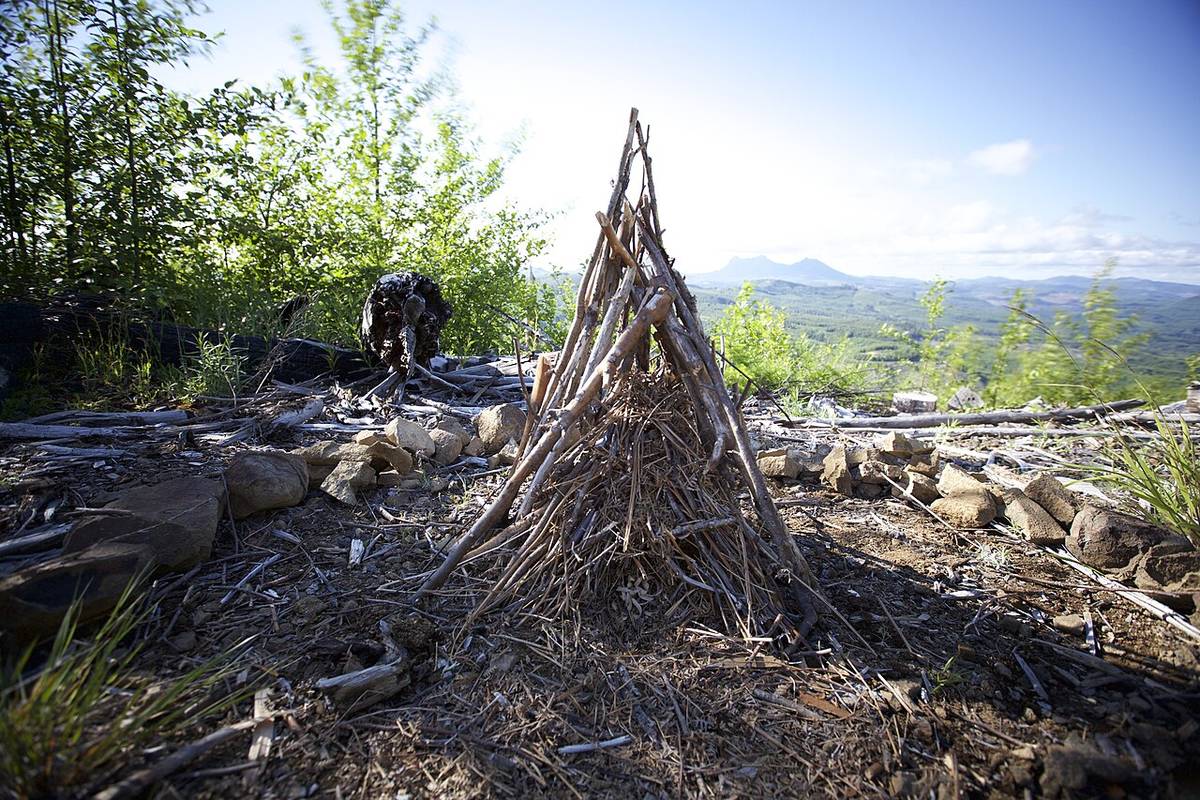
Tepee lay: kindling leaned in a cone over the tinder, lit at the center Lean-to: push a green stick into the ground at a 30 degree angle with its tip pointing into the wind. Put tinder deep under it, lean kindling against it, and light the tinder. Add kindling as it catches. The green stick acts like a little roof that shields the tinder from wind. Pointing it into the wind lets the breeze push the flame up into the kindling.
Cross-ditch: scratch a cross about 1 foot (30 centimeters) across and 3 inches (7.5 centimeters) deep in the ground. Put a large wad of tinder in the middle and build a kindling pyramid over it. The ditch lets air sweep under the tinder for draft. The cross is two short trenches that cross in the middle, about 1 foot across and 3 inches deep. Air flows along the trenches and under the tinder, so it burns well on still days.
Pyramid: lay two small logs parallel on the ground and a solid layer of small logs across them. Add three or four more layers, each smaller than and at a right angle to the one below. Light a starter fire on top. It burns downward and needs no attention during the night. Each layer is smaller and turned the other way, like a log cabin. It burns from the top down, so it lasts a long time without care. FM 21-76-1 and the MWTC handbook say this lay gives lots of light and heat, dries out wet wood and leavesdebris Dry leaves, pine needles, grass and ferns. Piled deep they trap still air, which is what keeps you warm. coals for cooking.
Always light from the upwind side, and lay the fire so it will burn as long as you need it. Upwind is the side the wind is blowing from. Lighting there lets the wind carry the flame into the wood instead of back at your hands.
Dakota fire hole: dig a hole, poke a second, connecting hole on the upwind side for air, and build the fire in the hole. It hides the flame and cooks well. The air hole pulls in fresh air like a chimney. The MWTC handbook says it burns with less smoke and is easier to light in high winds. Dig it in bare soil, away from roots.
For cooking, a bed of hot coals beats flames. Coals from a crisscross fire settle evenly. A crane propped on a forked stick holds a pot over the fire. Flames flicker and blacken pots. Coals give steady, even heat. A crane is a long stick that holds a pot out over the fire, resting in the fork of a forked stick.
The manual's hints: use seasonedseasoned Wood that has dried out for months. It lights easier, burns hotter and smokes less than fresh, green wood., non-aromatic hardwoodhardwood Wood from trees with broad leaves, like oak, maple and hickory. Burns long and makes good coals. when you can; do not pick wood lying on the ground, which looks dry but is not; dry damp wood beside the fire; collect kindling and tinder as you walk; bank the fire overnight; and be sure it is out before you leave. Nonaromatic means wood without the strong sap smell of pines and other evergreens; FM 21-76 says those make more and darker smoke. The MWTC handbook adds that hardwoods leave a good bed of coals, while softwoodssoftwood Wood from trees with needles and cones, like pine and spruce. Lights fast and burns hot but quickly, with sparks and pitch. burn hot and fast with sparks. Banking a fire means pushing the coals together and covering them so they stay hot overnight.
Tips from survival instructors
- Start small: a fist-size bundle of tinder, then pencil-thin sticks, then thumb-thick sticks, then wrist-thick wood. Do not rush to big logs.
- Fire needs air. Leave gaps between sticks. Piling wood on too tightly smothers a young fire.
Common mistakes
- Packing the wood too tight. Fix: leave gaps so air can move through.
- Adding big wood too early. Fix: feed small pieces until the kindling is burning well, then step up in size.
- Lighting from the downwind side. Fix: kneel with the wind at your back and light the upwind side.
- Cooking over tall flames. Fix: wait for a bed of coals.
- Using only softwood for a long fire. Fix: add hardwood for coals that last.
Practice it safely
You can practice every lay without lighting anything. On a driveway, patio or table, build each of the four lays with sticks and paper strips, then take them apart. Time yourself and try to build each one without looking at the steps.
When you are ready to light one, do it only in a fire ring or fire pit where fires are allowed, with a grown-up and a bucket of water. Try the tepee first, then the pyramid. Only dig a cross-ditch or Dakota hole where digging is allowed, like your own yard with permission, and fill it back in when the fire is cold.
Quick check
From which side do you light a fire?
- Downwind
- Upwind
- The side nearest the shelter
Show the answer
Upwind
Take the quiz and earn the badge
The app checks your answers, keeps your place in the Fire, and works with no signal once saved.
Before you rely on thisA learning tool, not a replacement for training. In an emergency, call 911.
Sources
- US Army Survival Manual, pages 81 and 84 to 87 (fire principles, Dakota fire hole, fire lays), 90 to 91 (hints) and 202 (cooking coals)
- US Army Survival Manual, pages 81 (fire triangle), 84 to 87 (Dakota fire hole, tepee, lean-to, cross-ditch, pyramid, light from upwind), 90 to 91 (helpful hints), 201 (resin woods smoke more) and 202 (coals for cooking, crane)
- Military Survival and Rescue Guide, page 67 (tepee for concentrated heat, log cabin or pyramid for light, heat and coals)
- Marine Corps Winter Survival Handbook, pages 21 to 24 (Dakota hole, hardwoods and softwoods, tepee and pyramid uses)