Animal sign
Mountain lion tracks: big, round prints with no claws
Mountain lions (also called cougars or pumas) live mostly in the West and in Florida, and few people ever see one. Their tracks are big, round and clawless, and knowing them helps you tell a lion from a large dog.
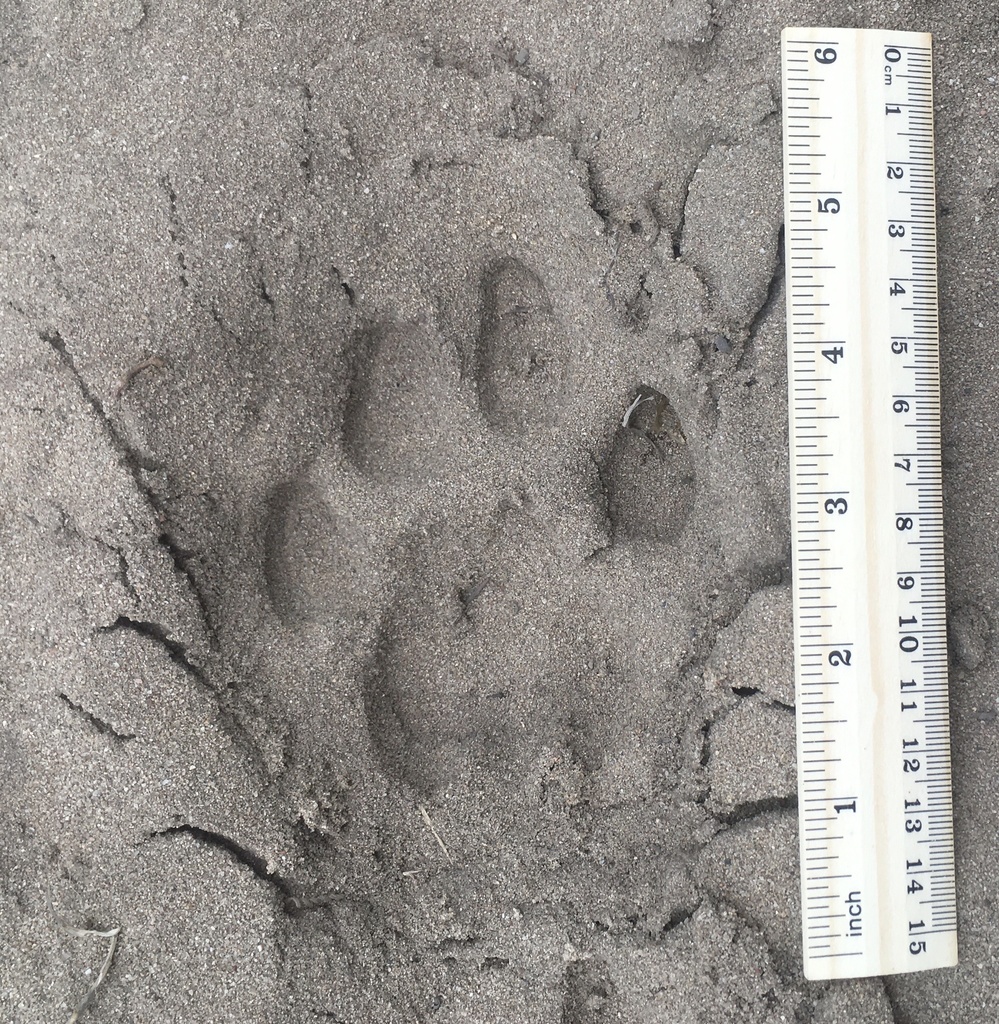
How to tell it
- Round prints 3 to 4 inches across, about as wide as they are long.
- Four teardrop-shaped toes and usually no claw marks.
- A large heel pad with three lobes along the back edge and two bumps along the front.
- One front toe leads a little ahead of the others, like the longest finger on a hand.
Where you find it
Across the western states, from the Rockies to the Pacific, in parts of Texas and the Dakotas, and in southern Florida, where they are called Florida panthers.
Scientific name: Puma concolor
Look-alikes
Oval, with claw marks on the toes and a heel pad with a single lobe at the back.
Same shape but half the size, about 2 inches.
Very large too, but oval, with claw marks and toes that line up evenly.
What it tells you
Mountain lion attacks are very rare, but fresh tracks mean one is hunting in the area. Lions usually hunt deer at dawn and dusk. The National Park Service says to keep children close and never hike in lion country with small children running ahead.
What to do
- Hike in groups and keep children within reach.
- If you see a lion, do not run. Stand tall, open your jacket to look bigger, and back away slowly while facing it.
- If it comes closer, shout and throw rocks or sticks. If attacked, fight back.
- Report fresh tracks near trailheads or campgrounds to park staff.
The free app reads your photo, names the likely match, shows its look-alikes, and tells you what has been seen near your ZIP code.
Sources
Written in our own words from these public sources.