Poisonous plant
Giant hogweed: the plant whose sap burns in sunlight
Giant hogweed looks like a Queen Anne's lace the size of a small tree. Its clear sap causes severe burns and blisters when the skin is then hit by sunlight, and sap in the eyes can cause blindness.
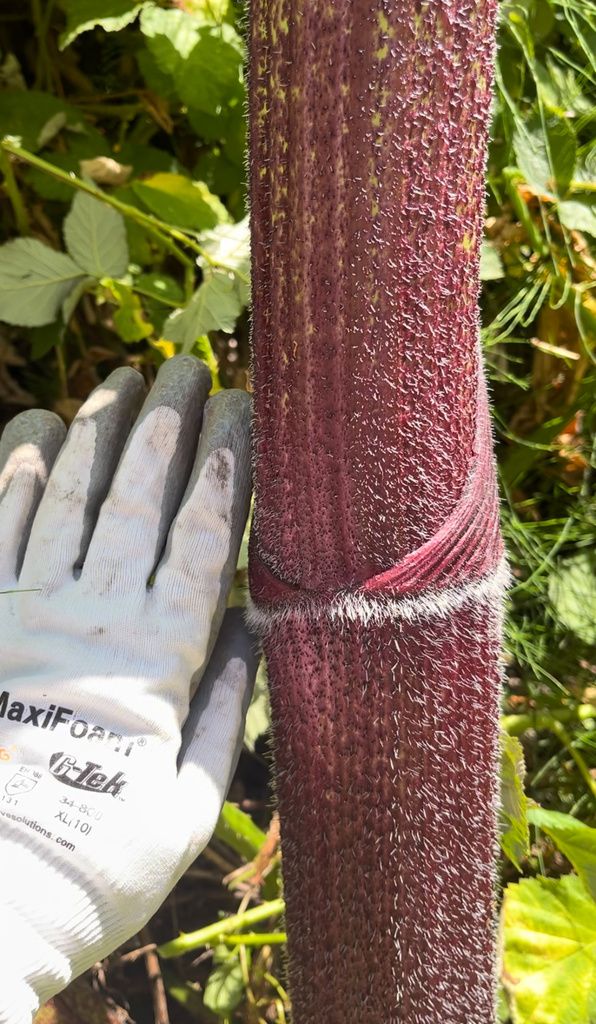
How to tell it
- Huge: often over 6 feet and up to about 15 feet tall when flowering.
- Thick, hollow, ridged stem with purple blotches and coarse white hairs.
- Deeply cut leaves that can spread up to 5 feet across.
- Broad, flat-topped umbrella clusters of small white flowers in early summer.
Where you find it
An invasive plant from Asia, brought over as a garden curiosity. In the US it is found mostly in the Northeast, the Great Lakes states and the Pacific Northwest, along streams, roadsides and disturbed ground.
Scientific name: Heracleum mantegazzianum
Look-alikes
A native cousin, usually 4 to 10 feet, with fuzzy stems and no big purple blotches. Its sap can also cause burns, so avoid both.
Smooth, purple stem without hairs, and round, ball-shaped flower clusters.
Only 1 to 3 feet tall with a hairy stem. The size alone usually tells them apart.
Why it is dangerous
The sap holds chemicals that make skin react to sunlight. Burns can blister badly and leave dark marks or scars for months or years. The danger is highest on sunny days and when cutting or mowing the plant, which sprays sap.
What to do
- Wash the skin right away with soap and cold water.
- Keep the area covered and out of the sun for about 48 hours, as the National Park Service advises.
- If sap gets in the eyes, rinse with clean water for several minutes, wear sunglasses, and get medical care.
- See a doctor for blisters or a large burn. Never mow or weed-whack it without full protective clothing and eye protection.
The free app reads your photo, names the likely match, shows its look-alikes, and tells you what has been seen near your ZIP code.
Sources
- National Park Service: Species spotlight, giant hogweed
- US Fish and Wildlife Service: Don't touch these plants!
Written in our own words from these public sources.