Poisonous mushroom
False morel: the spring mushroom that poisons morel hunters
False morels come up in spring, in the same woods and weeks as true morels, and every year they poison people who mistake one for the other. The surest check is to slice it in half from top to bottom.
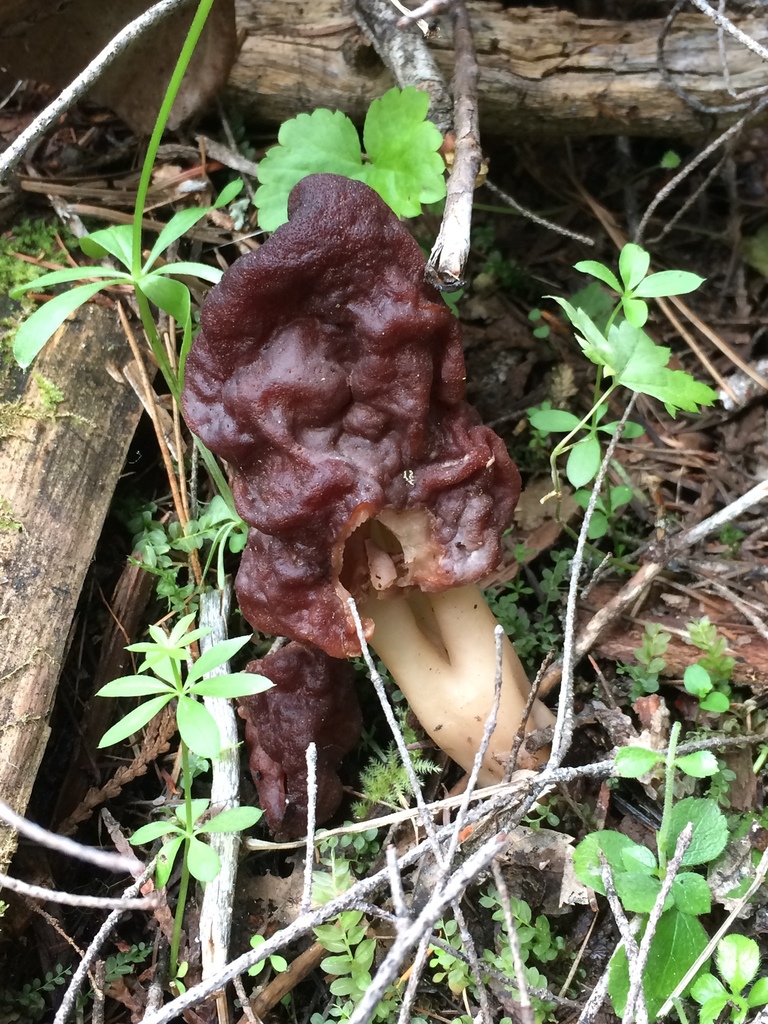
How to tell it
- Cap wrinkled and folded like a brain or a saddle, not pitted like a honeycomb.
- Reddish brown to dark brown, often with a short, thick, pale stem.
- Cut in half lengthwise: the inside is stuffed with cottony fibers or split into chambers, not one hollow tube.
- The cap edge often hangs loose around the stem like a skirt.
Where you find it
Under conifers and in mixed woods across the northern US, the Great Lakes, the Northeast, the Appalachians and the West, in early to late spring.
Scientific name: Gyromitra
Look-alikes
A cap of deep pits and ridges like a honeycomb, joined to the stem at its base, and hollow from the tip down through the stem when cut in half.
The cap sits on top of a long stem like a thimble or a skirt. These also make people sick.
Why it is dangerous
False morels hold gyromitrin, which the body turns into a compound related to rocket fuel. It causes vomiting, diarrhea, dizziness and headache, and can damage the liver, the blood and the nervous system, with seizures, coma and death in bad cases. Even the steam from cooking them can make people sick, and the amount differs from mushroom to mushroom.
What to do
- If someone eats one, call Poison Help at 1-800-222-1222 right away, even before symptoms start.
- Call 911 for a seizure, confusion or someone who will not wake up.
- Save any leftover mushrooms in a paper bag for the poison center or doctor.
- Never eat any wild mushroom unless an expert has checked that exact mushroom in person.
The free app reads your photo, names the likely match, shows its look-alikes, and tells you what has been seen near your ZIP code.
Sources
- Michigan Poison and Drug Information Center: 19 years of Gyromitra poisonings in Michigan
- US Army Survival Manual, page 128
Written in our own words from these public sources.